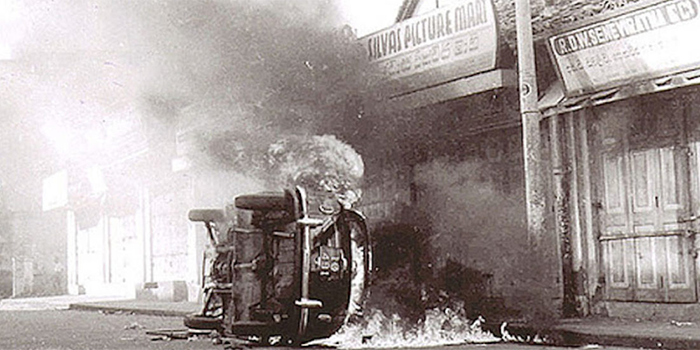
Article | Sanjula Pietersz | Picture | Photographer unknown
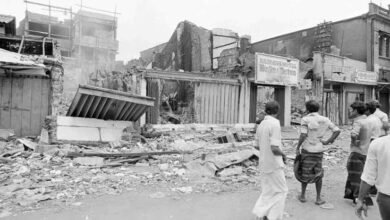
More than four decades have passed since the blood-soaked events of July 1983 began to be described as “July disturbances” or “racial riots,” yet we are still compelled to write about those murderous days for which justice has never been delivered. What we write about is not the fading lamentations surrounding so-called “ethnic unrest” or “racial riots,” but rather the mortal suffering and unimaginable injustices they entailed. In the aftermath of the anti-Tamil violence of July 1983, there was little to write about in terms of murderers and perpetrators being brought to justice. Instead, what unfolded was, on the one hand, a chain of massacres that culminated in May 2009, and on the other, attempts to document those events in history according to the preferences of the state. As a result, what remains within southern discourse on 1983 Black July is not a discussion of a pogrom for which justice has yet to be served, but an aestheticized and revised version of history.
What is this revised historical narrative?
According to this narrative, Black July is reduced to a collection of stories about “majority Sinhalese” who rescued Tamils while they were being attacked and killed by a “small group of thugs.” These stories are convenient fictions that strengthen the ethnic compact between the state and us, the Sinhalese people, thereby making our political lives more comfortable. Transformed into poems, songs, novels, films, and tele dramas, these narratives may comfort and gratify us as Sinhalese, but they do not compel us to confront the structural political problem of the Sri Lankan state that was laid bare through the violence unleashed upon the Tamil people in July 1983.
Myths of Black July: ‘The Aggressive Other’ and ‘The Tolerant Us’
We construct historical narratives by revising those aspects of history that are difficult for us to confront, reshaping them into forms that are more comfortable and acceptable to us. This is because, otherwise, our collective identity would be thrown into crisis. Within this revised majoritarian historical narrative of the Black July pogrom are a range of stories, from the fiction that Black July was a carefully planned act by the Tamil people themselves, to the claim that it was carried out by a small group of thugs backed by the state. According to the dominant thinking among the majority in the Sinhala South, Black July is nothing more than a collection of such myths and fictional narratives, necessary to sustain this revised version of history.
According to the dominant narrative within the Sinhala society, the anti-Tamil violence of 1983 consisted of isolated acts carried out by a group of state-sponsored thugs with no connection to the general public. Yet, if Black July was indeed a heinous crime committed by a small minority, history confronts us with an important question. That is, what was the majority doing at that moment? What did the society that now speaks of these atrocities more than four decades later do at the time they were taking place? What were the political parties and political movements in the Sinhala society doing at that moment? Was the ruling party which burned and murdered Tamils on the streets the only organized force in the country? If not, what were the other organizations and political forces doing at that time?
A study of this history through the testimonies of victims makes it clear that ordinary Sinhalese people, who had until then shared their everyday lives with Tamil people, played a significant role in enabling and unleashing violence against them. Those who enthusiastically participated in the looting and theft of property were not merely “government-backed thugs”; the accounts of victims suggest that ordinary Sinhalese people, too, were involved to a considerable extent.
According to the dominant narrative about 1983, Black July was a reaction by Sinhala people angered by the killing of thirteen soldiers by the Liberation Tigers of Tamil Eelam (LTTE) at the Thirunelveli junction in Jaffna. To some extent, this was also the interpretation offered by Sri Lanka’s then President, J.R. Jayewardene. Yet history confronts us with a different reality: a pattern of state-sponsored ethnic discrimination and violence against Tamil people that dates back to 1956. Even if we consider 1983 alone, numerous incidents of violence against Tamil people from killings to the burning of homes were reported in the North and East from as early as March, months before July.
We do not seek out this history because it unsettles our collective sense of self. This is not due to a lack of sources or evidence. Rather, according to the revised history that has been made available for our consumption, our past consists of stories about “the aggressive other” and “the tolerant us.”
It is for this reason that the Black July pogrom has come to be interpreted as a tragic yet understandable event.
Our Structural Problem
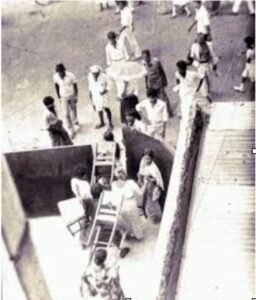
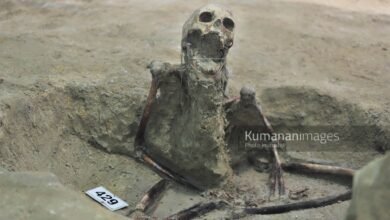
That an event like “Black July” never occurred again after 1983 is another narrative we Sinhalese like to hear. However, what actually happened after the 1983 Black July was that the violence was better organized and legitimized by the state itself. Accordingly, after Black July, the Tamil people fell victim not to violence unleashed by disorganized mobs, but to violence officially unleashed by the state. Thus, the majority of robberies, sexual violence, and killings that took place after 1983 were carried out by armed forces possessing official authority and, consequently, legal impunity. Even the daily lives of the Tamil people bear witness to this organized, racist state-sponsored violence, which did not end even with the extreme atrocities of 2009. The Muslim people, too, fell victim to this more organized form of violence.
The state repression unleashed upon a handful of activists including students and mass organizations who continued to protest even after the anti-government uprising that spread across the South in 2022 is also an important lesson teaching us about the nature of the state we live in. That is, the destructive capacity that lies at the very heart of the Sri Lankan state.
Sri Lanka has a history where governments elected through democratic elections carried out mass atrocities decade after decade. The state did not need to change its fundamental nature to commit these crimes. Because the primary victims of this were the Tamil people, and because the Sinhalese people have collectively agreed to forget the mass violence they themselves lived through in the past, the Sinhalese as a society are unable to politically grasp that this destructive capacity is a structural problem of the state we live in.
Consequently, we are inclined to believe that the 1983 anti-Tamil Black July pogrom was an accidental event that occurred while history was flowing normally. This is precisely why there is a need to revise this true history of mass violence and aestheticize it through cultural spectacles.
The Sinhalese people too, particularly during the 1987-89 period, experienced state brutality firsthand. Following the 1987-89 mass state violence in the South, the political movements that experienced it, as well as the social classes upon which those movements were based, possessed the capacity to grapple with this issue regarding the state. Yet, in the aftermath, even the political movement that had previously fallen victim to state repression deliberately shirked the responsibility of staging any form of organized resistance against the brutal acts unleashed by the government targeting other communities. Not only did they decide not to protest, but they also actively contributed to those crimes. Even today, they are not prepared to take an open political stance against state criminality. This collective agreement to maintain silence over state criminality demonstrates the ethnic ties the Sinhalese people share with the state apparatus. This connection strips them of the ability to acknowledge the criminal nature inherent at the very core of the state. All the distorted positions held by Southern protesters from celebrating the very state armed forces and declaring allegiance to them while simultaneously falling victim to their crackdowns, to arguing that ‘it was not the state military that launched the repression’ demonstrate the true nature of this compromise with the state.
If anyone wishes to understand 1983 Black July, as well as the Sri Lanka that existed before and after it, they must realize that the state’s massive destructive capacity, the impunity granted to those responsible, and the fact that the majority population is unbothered by this are not mere accidents, but a structural political problem. Efforts to justify the horrific crimes committed by the state, and to become complicit in them, demonstrate a deep structural issue regarding the relationship between the social fabric of the South and the apparatus of the state.
To avoid this issue is, in essence, giving the state our own permission to suppress us.
Aestheticization: As a Convenient Substitute
Confronting the criminality of the Sri Lankan state as reflected by Black July plunges our collective existence into a crisis. Facing state criminality shatters our consensus with the state. Consequently, instead of grappling with the state’s destructive capacity, which is fundamentally a political issue, as a political problem, we are forced to shift it to a completely different level: a cultural one. Underlying our four-decade-long effort to obscure the crimes and bloodshed of Black July with poems, songs, plays, and stories about Sinhala people who saved Tamil people, is this very issue. In this comfortable narrative of Black July, there is no identity for the perpetrators, nor is there an ethnocratic state that operated to facilitate it. Instead, there is only a sorrowful tale about a handful of bad Sinhalese and a majority of good Sinhalese.
Why superficial, performative reconciliation activities are needed is to cover up and sustain this false narrative, masking the history of pogroms against the Tamil people and the majority community’s silence regarding them. This is exactly why there is a greater preference to rally around empty slogans like ‘Loving Jaffna,’ rather than standing in solidarity with the continuous struggle of the Tamil people, which is based on concrete political demands put forward for over half a century. It is also why a political problem is depoliticized and reduced to a mere issue of cultural misunderstanding between the two ethnic groups. Furthermore, this is the reason many prefer to view the Tamil people as a helpless community begging for our sympathy and love.
It is our own eager embrace of this self-fabricated narrative that allows us to take the stage on the pretentious, artificial, and aestheticized cultural platforms we have created for ourselves. Consequently, many are quick to label any Sinhalese who calls this cultural interpretation a shallow falsehood as an obstructionist of ethnic reconciliation, and any Tamil who thinks likewise as a racist.
As more than 43 years have passed since the 1983 Black July pogrom, the dominant narrative surrounding it serves to clear a path for evading the structural issues behind those events. This dominant narrative provides a comfortable story for those who are cautious not to touch the question of state criminality in Sri Lanka. The dominant narrative consists of fictionalized tales fabricated about the humanity and bravery of the Sinhala people, designed merely to bring tears to our own (Sinhalese) eyes.
It is because we have now become addicted to our own consumption of fiction that it is easy for us to dismiss the concrete political demands for ‘ethnic equality and justice’ emphasized by the Tamil people for decades, as the narrow demands of separatists opposed to reconciliation, and of those who abet that separatism.
Year after year, the 1983 Black July brings before us a problem that cannot be evaded by individuals and political movements who claim to engage in politics to change Sri Lanka. That is the question of how to build an inter-ethnic political solidarity that paves the way for constructing a political strategy capable of defeating the genocidal power of this ethnocentric state.
The foundation for this must not be cultural mourning, but political solidarity. It is only through this path that we can prevent the dark history created by 1983 Black July from becoming our eternal legacy.