Article by | Prof.S.Pathmanathan | Emeritus in History, University of Peradeniya
In 1970, Senarat Paranavitana published the texts and translations of 54 Brāhmi inscriptions, which had been discovered at four sites: Periyapuliyankulam (35), Orupotana (12), Mahakatchadkodi (04) and Vedukkunarimalai (03). All these localities are in the southern part of the Vavuniya District. These inscriptions are in a hybrid Prākrit that reveals the strong influence of Tamil and a dialect spoken by the people of the Mesolithic Culture who had lived in the island for a period of 28,000 years B.C.
Two of the four characters peculiar to Tamil Brāhmi are found in these inscriptions. As recognized by Saddhamangala Karunaratne, a former Archaeological Commissioner, the occurrence of la (ழ), which is one of the four letters specific to Tamil Brāhmi, is found in a record from the first of the afore mentioned localities. In this short record a trader who had the name Visakha is referred to as a Damēla which is a Prākrit form of the word Tamil. The frequency in the occurrence of the Tamil Brāhmi letter ḷa (ள) is comparatively higher in these inscriptions. It occurs as the last letter in the following word Parumakaḷa, Veḷa, Nuguyamaḷa and Sikaramaḷa.

“The letter ḷa (ள) of Tamil-Brāhmi is formed by attaching a small angular stroke (looking like an inverted L) to the letter. In course of time the attached stroke at the right of the letter move downwards or upwards. In late Tamil-Brāhmi, the right side of the letter and the attachment merge into a single vertical line.” Henry Parker recognized the occurrence of the Tamil-Brāhmi letter ḷa (ள) in some of the Brāhmi inscriptions in Sri Lanka. However, his view was unacceptable to the other European ideologists of the 19th and early 20th centuries. For some reasons of his own Senarat Paranavitana accepted their view. Nevertheless studies on Tamil-Brāhmi inscriptions in the late 20th Century clearly established that the letter l found in Sri Lankan Brāhmi inscriptions was adopted from Tamil-Brāhmi. In this connection the observations of Iravatham Mahadevan are noteworthy.
He Says:
“Parker’s identification of ḷa (ள) in the early Sinhala-Brāhmi inscriptions was disputed by Paranavitana even after the correctness of the identification was proved beyond doubt by the occurrence of the letter in appropriate linguistic contexts in the numerous Tamil cave inscriptions discovered since then. Paranavitana’s laboured attempt to read the letters as ḷu is unconvincing as forms like ḷi and ḷe occurring in Sri Lankan cave inscriptions clearly indicate that the basic form must be a simple consonant. The loanwords from Tamil occurring in these inscriptions can be read meaningfully only if the letter in question is treated as ḷ. Karunaratne accepts the value ḷ and records the occurrence in five early inscriptions assigned by him to the 2nd Century B.C.E. He has pointed out that this form of ḷ was later replaced by the form in vogue in the Brāhmi inscriptions of India. The occurrence of ḷ in early Sinhala Brāhmi inscriptions proves the contemporaneity of the two scripts.”
As suggested by Karunaratne and endorsed by Mahadevan the Brāhmi inscriptions from Periyapuliyankulam could be assigned to the second century B.C. That a chiefdom had come into existence at that time is attested by the inscriptions from that site. The names of three generations of chieftains occur in these inscriptions. One of them is referred as raja Naga. As raja occurring in Brāhmi inscriptions has the same connotation as Veḷ it may be assumed that the inscription refers to a chieftain of Naga lineage. His daughter Anuradhi and her husband Raja Uti had donated a cave to the Buddhist Sangha as recorded in some of the inscriptions from the same site.
In these records the word abi is prefixed to the name Anuradhi. In Sri Lankan Brāhmi inscriptions the word abi occurs as the designation of women of ruling families of the rank of chieftains and kings.
The text recording the donation made by AbiAnuradhi and RajaUtiya is engraved in four copies at the same site. This practice is unusual in Brāhmi inscriptions. It could be explained only by taking into consideration the traditions of the Nagas as evident from Tamil Brāhmi inscriptions. They had developed the peculiar habit of engraving the same words or expressions several times again and again on the same stone. The number of such receptions depended on the availability of space on the surface of the sites of a stone. The most striking sample of this phenomenon is the long massive rock at Neṭuṅkēṇi in the Vavuniya District. This stone, which is about 40 feet in length has curves at several points and resembles the figure of a snake in motion.
That the occurrence of Tamil words in the Brāhmi inscriptions from the epigraphic sites identified by Senarat Paranavitana suggest the existence of Tamil communities in the region in the Early Historic Period. In fact the notices on the Barata and Naga ethnic groups confirm such an impression. The identification of Tamil words, expressions and names in a large variety of monuments found in vanni districts has revealed that Tamil was spoken widely in the Vanni region. Naga stones, Caves, rocks, grinding-stones, terracotta images, stones on the bunds of tanks and images of the Budha and deities of the Saiva pantheon are among the monuments, which bear Tamil inscriptions engraved in Tamil-Brāhmi characters.

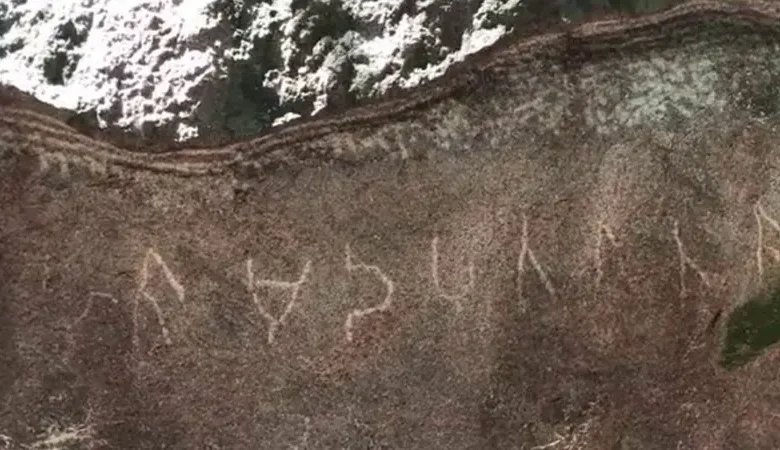
The Tamil-Brāhmi inscriptions from Vedukkunarimalai only samples of a phenomenon that was a dominant characteristic of social formation in the Vanni region of the Northern Province. The views articulated here are based on a preliminary examination of the copies of photographs taken recently by a groups of persons who had visited the site because of curiosity. The photographs illustrated here include those of a cave and some sections of the surface of a gneissic outcrop, which terminated, on the left, with the area of the cave. The cave is substantially large in dimensions with a capacity to accommodate a family of five to six persons. It has the appearance of an excavated structure.
On a large rock on the left side of the cave, which is the limit of the extremity of the hill on one side, there are Tamil-Brāhmi letters of medium size. As they are clearly visible at some places it is possible to identify the letters and construct the text. The expressions VēḷNakan makanVēḷKaṇṇaṇ are clearly visible. These form the first of the two sentences usually found in the inscriptions of the Nagas wherever they are found in the island. As the letters are worn at many places on the inscribed portions of the rock it is not possible to identify the second sentence of the inscription. There is no indication about the existence of a dripledge cut on the front side of the roof of the cave. Unless the cave is examined personally it is difficult to decide whether it was a residence of Naga chieftains or a Shrine of the Naga cult. There are no symbols of any religious tradition here.
There are two other places on the rock where inscriptions in Tamil-Brāhmi characters are found. At the centre of one of these places is a deep and circular cavity excavated on the rock. The size and depth of the cavity suggest that it was not used for conserving or obtaining water. As it is surrounded by inscriptions it may, perhaps be assumed that it was used for the performance of some rituals connected with the Naga cult. The letters indicated on the rock at this place are very similar but mostly worn out yet, with some ingenuity and the experience gained by identifying a large number of inscriptions of a similar character it can be confidently asserted that the full text of usual inscriptions of the Nagas comprising two sentences were inscribed here.

The text reads:
vēḷnākaṇmakaṇvēḷKaṇṇaṇ
vēḷKaṇṇaṇmakaṇvēḷnākaṇ
“The son of VēḷNākaṇ is VēḷKaṇṇaṇ. The son of VēḷKaṇṇaṇ is VēḷNākaṇ”
In conformity with a tradition of the Nagas the text is inscribed repeatedly on the rock on a number of times.
The third area on the rock that merits attention is a spot where an unidentified object of an irregular shape is found. There is a cavity resembling a cavern on the top. Perhaps, it symbolically represents the abode of the Nāga deity. An identical inscription as the one found at other places is indited here repeatedly.
The Tamil-Brāhmi characters in the inscriptions of Vedukkunarimalai belong to the earliest stage of development. Besides, the overlapping Brāhmi inscriptions found here seem to have been engraved over the Tamil inscriptions. Such a circumstance presupposes that the Tamil inscriptions belong to an earlier period and that the Nāgas were in occupation of the area when the Brāhmi inscriptions were engraved. The inscriptions are in Prākrit and engraved in Brāhmi characters derived from contacts with North India and Central India.
It is significant that there is a convergence of two languages and the cultural traditions characteristic of them at Vedukkunārimalai. The texts of the Tamil inscriptions clearly reveal that they record the titles of Naga Chieftains. They do not record personal names. But the three Prākrit inscriptions found here record personal names but do not reveal the ethnic identity of the persons concerned. The personal names are derived from Prākrit and these inscriptions record the donations of caves to the Buddhist Sangha.

The occurrence of Brāhmi and Tamil Brāhmi inscriptions at Vedukkunarimalai is of considerable interest in understanding the process of inter cultural communication that was in vogue during the Early Historic Period in the island and particularly in the Vanni region. Inscriptions in the two languages are found to overlap at certain places on the inscribed surfaces of the rock. The Brāhmi inscriptions, which are engraved in large characters appear to have been incised over the Tamil Brāhmi records and such a circumstance suggest that the Nāgas were already in occupation of the site before Prākrit was adopted as the language of the records. Such an impression is supported by paleographic considerations.
The formation of the letters, ḷ and n̲ in the Tamil Brāhmi inscriptions represent an early stage in the development of Tamil Brāhmi. Such a situation presupposes that the Nāgas residing at this particular locality had adopted Prākrit as a language of communication after their conversion to Buddhism as at several other localities in the island. Kusalāṇmalai is another location where such a development had taken place. There, the name Maṇin̲akaṇ was engraved on a Nāga stone and a footprint of the Buddha at the foot of the hill. On the drip ledges of caves on the mountain there are seven Brāhmi inscriptions recorded in Prākrit. All these inscriptions record donations made to the Sangha. The first record mentions the donation made to the Sangha by Gamini Tisa, a grandson of uparājaNāga. Significantly this epigraph records the names of the three generations of chieftains of Nāga lineage. The name Bata occurs in three other inscriptions as the name of community or the ethic group to which the donors had belonged.
The overall impression gained from a comparative examination of the epigraphic records found at Kusalāṇmalai in the Batticaloa District of the Eastern Province that the Nāgas were bilingual. They spoke Tamil and adopted Prākrit as a medium of communication in a society the population of which was of a composite character. The Nāgas and the people of the Mesolithic Culture were numerically preponderant in that population.
The Sri Lankan Brāhmi inscriptions are uniformly in Prākrit and pertain exclusively to Buddhism. Yet, Prākrit attained the position of a language of communication among all ethnic groups and communities living in a major part of the island during the Early Historic Period, especially as a result of their conversion to Buddhism. The inscriptions from Vedukkunaimalai provide the indication that the Nāgas had used Tamil and Prākrit a media of communication simultaneously. They had used Tamil for recording matters pertaining to secular affairs or the Nāgacult, in recording the donations to Buddhism they had adopted Prākrit.
References
- S. Paranavitana, Inscriptions of Ceylon (IC) Volume I, Department of Archaeology, 1970, Nos: 322-375.
- S. Karunaratne, Lithic and other inscriptions of Ceylon, Epigraphia Zeylanica (EZ) 7, Department of Archaeology, Colombo, 1984, PP 32-33
- IC, No: 356
- Iravatham Mahadevan
- Parumakaḷa Pusa is described as a daughter of parumaka Sata Nasata and a wife of parumaka Mita. As parumakaḷa is a Prākrit form of the Tamil (Dravidian) word paramakal the word parumaka may be considered as the Prākritized masculine form of the Tamil word Parumakan meaning “the chief” or “leader” IC, Nos: 33″, 353, 355. The names Nuguya-Vēḷ, Nuguyamaḷa and Sikaramaḷa have been erroneously identified as Nuguya-Velu, Nuguya-malu and Sigara-mālu because of his uncompromising position regarding the identification of the letter ḷa(s) occurring in these inscriptions (Ibid, P.28). In Brāhmi the letter lu is formed by the addition a small vertical stroke below the letter la as could seen in the photographic illustrations of Nos: 178, 412 in IC. In these records the letter lu is engraved as in Brāhmi.
- Iravatham Mahadevan, Early Tamil Epigraphy (ETE), Revised and enlarged second edition Volume I – Tamil Brāhmi Inscriptions, Central Institute of Classical Tamil, Chennai, 2014, P. 230-231.
- A chieftain called Rāja Nāga is mentioned in four Brāhmi inscriptions recording the donation of a cave made by his daughter Abi Anuradhi, her husband Raja Uti. IC, Nos: 338-341. Besides Cuḍi Nāga, a son of Parumaka Uti had donated a cave to the Sangha. At this site Cuḍi Nāga seems to have been a person of the class of elite because his father had the designation parumaka meaning “chief” of “leader”. IC, No: 243 Pathmanathan, “Vanniyil Nakar Uruvakkiya Aracu”, Vanni Varalārum Paṇpāṭum, P 1-12.
- The co-existence of people of three ethnic groups, the Nagas, Baratas and Bata is attested by the evidence from the inscriptions copied from the four sites in the Vavuniya District and published in the IC, in 1970. Recently P. Pushparatnam has identified some inscriptions from a site in Ceṭṭikuḷam, which contain references to the Baratas. Besides he has published the photocopy of bilingual inscription. The text of this record reads: pokumpurvēṭankalperumnāviy line. The first word seems to denote a place-name adopted from the language of the people of the Mesolithic Culture. The last word in the text is a Prākrit word. The second and third items are Tamil expressions Vitanakal is obviously a place in suggesting that it was occupied by the Vēṭar of hunters. The leader of a group of mariners engaged in seaborne trade is the connotation of perumnāviy, which is a variant of Mānavykāṇ (mahānavikaṇ) mentioned in the Cilappatikaram of a later date.
- Aruna Cellatturai, Aṭaṅkappatru Vanniyil Atikalat Tamil-ar Varlaru (Ancient History of the Tamils in Adankappattu Vanni the Nāgas and Their Monuments, Aruna Veliyittakam, Vanuniya, Ilaṅkai 2016.
- S. Pathmanathan Ilaṅkait Tamilar Varalaru Bc 250-Ad. 300 Kilakkilankaiyil Nakarum Tamilum, Department of Hindu Religious and Cultural Affairs, Colombo, 2017.
- Ibid
- These sentences are engraved uniformly on all items that belonged to or were created by Nāga Chieftains. They are mostly found on socket-stones, grind-stones, oil presses and mortars.
- S. Pathmanathan Ilankait Tamiḷar Varalaru…
- S. Paranavitana, IC, Nos: 389-395.
Courtesy: Kalaikkesari, July 2018.