Article: J Keshayinie Edmund | Picture | Sri Lanka Campaign
There was a time when violence shocked us. Today, it entertains us.
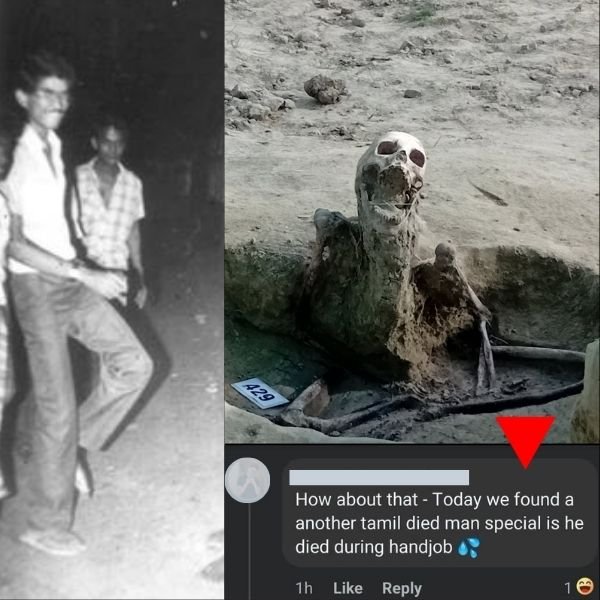 Images of suffering circulate online—bodies, graves, stories of loss—and beneath them, something even more disturbing appears: laughter. Jokes. Mockery. Comments that reduce human tragedy to amusement. The recent reactions surrounding discussions of Chemmani are not just insensitive—they are deeply revealing of who we are becoming as a society.
This is not merely about “bad behavior” on social media. It is something far more dangerous. It is a sign that we are forgetting how to feel.
The Psychology Behind Cruelty
In the 1960s, psychologist Stanley Milgram conducted a now-famous experiment. Ordinary people were instructed to administer electric shocks to another person. Despite hearing screams of pain, most participants continued—simply because an authority figure told them to.
Milgram’s conclusion was chilling: ordinary people can commit harmful acts when influenced by authority and environment.
But today, authority does not always wear a uniform. It lives in our timelines, our comment sections, our peer groups. When cruelty becomes normalized, people follow—not because they are inherently cruel, but because they are conditioned not to resist.
From Black July to Chemmani: A Pattern We Refuse to See
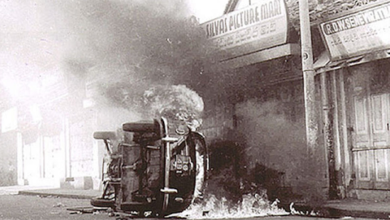
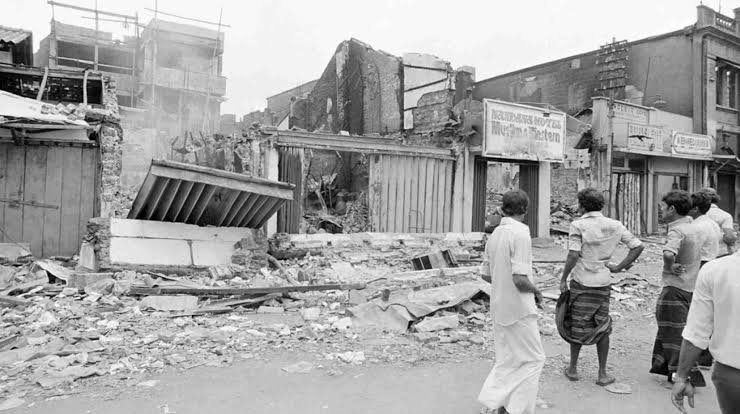
Sri Lanka has seen this before.Black July represents one of the most significant episodes of ethnic violence in Sri Lanka, characterized by widespread attacks against Tamil civilians. The scale and intensity of the violence suggest the operation of collective psychological mechanisms. Black July (1983), violence erupted not only through organized structures but also through ordinary individuals caught in the tide of collective rage. Responsibility dissolved into the crowd. Humanity was replaced by identity.
Chemmani, by contrast, represents a quieter horror—one of silence, denial, and buried truths. The violence was not performed in public streets, but hidden beneath the earth. Yet the psychological mechanisms remain the same: obedience, detachment, and the gradual erosion of empathy. What connects these events is not just history—it is human behavior.
A New Form of Violence: Mockery
Today, the violence has evolved. It no longer always requires weapons. Sometimes, it only requires a keyboard. When young people laugh at victims, when suffering becomes a meme, we are witnessing what psychologists call moral disengagement. Pain is no longer real. Victims are no longer human. Tragedy becomes content.
This is not harmless humor. It is the final stage of a long psychological process: First, we justify violence – Then, we ignore it – Finally, we laugh at it. And when we laugh, we complete the transformation—from witness to participant.
The Danger of a Desensitized Generation
Young people are often blamed for these reactions. But the truth is more uncomfortable. They did not invent this culture. They inherited it. They grew up in a society where:
- Justice was delayed or denied
- Narratives were divided along ethnic and political lines
- Violence was explained, excused, or forgotten
When a generation is raised without accountability or collective truth, it learns not empathy—but indifference. And indifference is fertile ground for cruelty. This Is Not Just About the Past.It would be easy to dismiss this as a problem of history. But it is not. Every joke about a victim, every mocking comment, every moment of silence in the face of injustice—these are not isolated acts. They are signals of a deeper societal condition. A society that laughs at suffering is not healed. It is wounded in ways it refuses to acknowledge.
Milgram’s experiment teaches us that humans are capable of both obedience and resistance. We can follow the crowd or we can question it? We can normalize cruelty or we can refuse it? We can laugh or we can remember?
The issue is not whether atrocities like Black July or Chemmani happened. The real question is this: What kind of society do we become when we no longer feel them? Because the moment we laugh at the dead, we are no longer just forgetting history—we are losing our humanity.
The disturbing reality captured in such images is not confined to the past. Even today, we continue to witness a dangerous human tendency — the ability to laugh at, dismiss, or enjoy the suffering of others. This psychological detachment is not merely an individual failure of compassion; it reflects a deeper social process where violence becomes normalized and victims are dehumanized.
The events of Black July 1983 and the Chemmani mass grave discoveries reveal how ordinary people can become silent spectators, participants, or even observers who emotionally distance themselves from the pain of others. As demonstrated in Stanley Milgram’s obedience experiments, individuals may suppress their moral responsibility when they feel protected by authority, group identity, or social acceptance. In such environments, cruelty can gradually become acceptable, and empathy can disappear.
The most dangerous warning for any society is not only the act of violence itself, but the laughter, indifference, and justification that surround it. When people mock the suffering of victims, celebrate humiliation, or treat tragedy as entertainment, they create the psychological conditions that allow future atrocities to occur.
Remembering Black July and Chemmani is therefore not only about remembering the victims of the past; it is a call to examine our own humanity in the present. A society that loses the ability to feel another person’s pain risks repeating the darkest chapters of its history. The first step toward preventing violence is to restore empathy — because the moment we stop seeing victims as human beings is the moment humanity itself begins to fail.