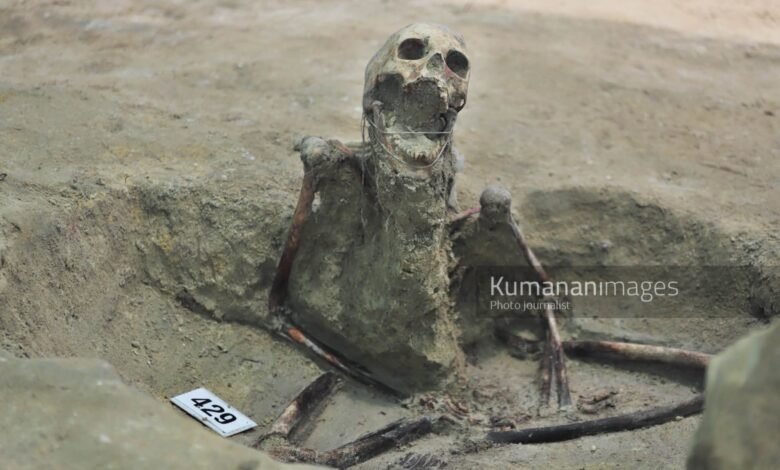
429..! A Silent Witness from Chemmani
Article | J Keshayinie Edmund | Pictute | Kumanan Kanapathippillai
Forensic Interpretation of Skeleton 429 from the Chemmani Mass Grave, Sri Lanka: Analysis of a Flexed Seated Burial and Its Medico-Legal Implications
The discovery of Skeleton 429 at the Chemmani mass grave in northern Sri Lanka presents a unique forensic case characterized by an unusual seated, flexed burial position. Unlike typical extended or loosely flexed burials, this skeleton exhibits tightly drawn lower limbs and a forward-slumped torso. This article examines the forensic implications of such positioning, exploring whether it reflects spatial constraint, deliberate body manipulation, or postmortem bio mechanical processes. By integrating taphonomic observations, burial context, and forensic anthropology principles, the study highlights the complexities of interpreting clandestine burials within mass grave environments.
Mass graves represent some of the most challenging contexts in forensic anthropology, often associated with conflict, human rights violations, and clandestine disposal of bodies. The Chemmani mass grave in Jaffna, Sri Lanka, has emerged as one of the largest such sites in the country, with over 400 skeletal remains reported during ongoing excavations.These findings are widely linked to allegations of enforced disappearances during the civil conflict period.
Among these remains, Skeleton 429 has drawn particular forensic attention due to its highly unusual posture. The skeleton was reportedly found in a tight seated position, with knees sharply flexed toward the chest and the torso slumped forward, deviating significantly from typical burial patterns. This raises critical questions regarding the circumstances of death, body handling, and burial practices.
Skeleton 429 was recovered from a shallow, irregular pit, with soil layers indicating rapid and possibly hurried back-filling . The absence of a coffin, burial structure, or ceremonial arrangement aligns with broader patterns observed at Chemmani, where many bodies have been found in disorganized and non-formal burial contexts.
Shallow graves are commonly associated with clandestine disposal, as they require minimal effort and reduce the time spent at the burial site. In this case, the constrained dimensions of the grave appear to have directly influenced body positioning. The skeletal remains of Skeleton 429 were found in an articulated state, indicating that decomposition occurred in situ without significant post-burial disturbance . This is a critical observation, as it confirms that the posture observed today likely reflects the original deposition position.
Analysis of Body Position
Flexed Seated Posture: The most striking feature of Skeleton 429 is its tight flexion, with the body appearing almost seated. In forensic anthropology, such a position is highly unusual in burial contexts unless external constraints are present. Under normal circumstances, a human body after death undergoes muscle relaxation and typically collapses into a supine or lateral position. For a body to remain upright or seated, external support or confinement is usually required.
Possible Forensic Interpretations
- Spatial Constraint Hypothesis: One plausible explanation is that the body was placed in a narrow grave, forcing the limbs into a flexed position. The limited dimensions of the burial pit may have physically supported the body, preventing collapse. This interpretation aligns with patterns of hurried or concealed burials, where perpetrators minimize excavation effort.
- Deliberate Body Manipulation: The degree of flexion observed—knees drawn tightly to the chest—may indicate intentional positioning prior to burial. Such manipulation could occur:
- Before death
- Immediately after death
- During deposition
Some forensic interpretations also consider the possibility of symbolic or degrading positioning, although such conclusions remain speculative without corroborating evidence
- Restraint or Binding: Another hypothesis is that the individual may have been physically restrained, with limbs bound prior to burial. Over time, organic materials such as rope would decompose, leaving minimal direct evidence.
To confirm this, forensic examination would require:
- analysis of joint articulation
- identification of ligature marks on bones
- trace evidence in surrounding soil
- Postmortem Changes: Postmortem processes such as rigor mortis and ligament contraction must also be considered. Rigor mortis can temporarily fix the body in a particular position, while later decomposition may alter joint alignment. However, extreme flexion of this nature is less commonly explained solely by natural processes, particularly when combined with a constrained burial context.
- Possibility of Perimortem Circumstances: The posture has also raised questions regarding whether the individual may have been placed in the grave while alive or in a compromised state. While this cannot be determined from posture alone, forensic indicators such as:
- soil in airways
- signs of struggle
- perimortem trauma
would be required to support such a conclusion. Skeleton 429 provides a significant case study in the interpretation of body positioning within mass graves. The combination of:
- Seated posture
- Tight limb flexion
- Shallow burial
- Lack of formal burial structure
- strongly suggests a non-ceremonial and possibly clandestine deposition.
At Chemmani, where numerous skeletons have been recovered in irregular and disordered arrangements, such findings contribute to a broader pattern indicative of systematic and concealed burials. Similar characteristics—including shallow depth, absence of clothing, and disorganized placement—have been documented in other excavations at the site .
However, it is essential to emphasize that body position alone cannot determine cause or manner of death. Without detailed osteological, pathological, and forensic laboratory analysis, conclusions regarding homicide or specific circumstances remain provisional.
The forensic examination of Skeleton 429 highlights the complexity of interpreting human remains recovered from mass grave contexts. The flexed seated position may indicate:
- spatial constraint within a shallow grave
- deliberate manipulation of the body
- possible restraint
- or combined postmortem processes
While the evidence strongly suggests clandestine burial practices, definitive conclusions regarding the circumstances of death require further multidisciplinary investigation.
Skeleton 429 stands as a powerful reminder that even in advanced stages of decomposition, the human body continues to provide critical forensic evidence—evidence that may contribute to truth, accountability, and justice.
The presence of partial skeletal integrity alongside decomposition suggests an intermediate postmortem interval, likely ranging from several weeks to months, depending on environmental conditions such as soil composition, temperature, and microbial activity.
Skeleton 429 is more than an archaeological discovery — it is evidence of a human story waiting to be understood.