Who Killed Him?
Story and Picture | North East Narrative
Vadamaradchi East is a part of Jaffna. Within this region are many villages such as Manalkadu, Kudaththanai, Sempiyanpattu, Maruthankeni, Thaalaiyadi, Uduththurai, and Vettilaikkeani. Relying on the deep Indian Ocean that forms the border of this area, many families live here. The economic reality of these families is such that their hearths will only burn if the heads of the households return safely from the sea.
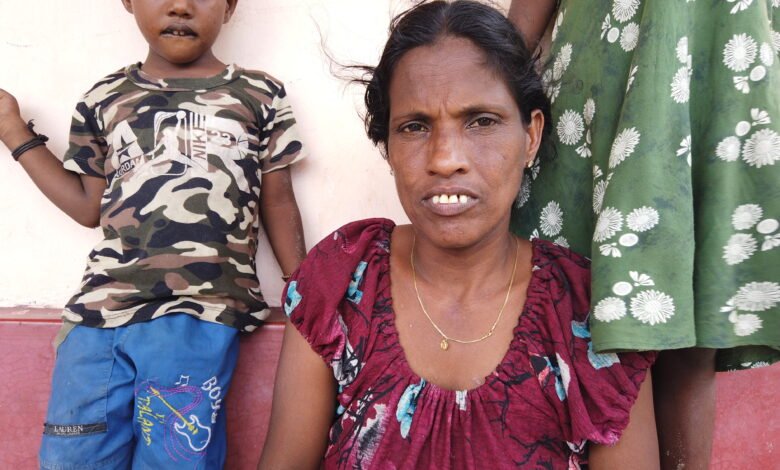
Among the families with this kind of economic background was the family of Premakumar Premaranjini, known
as Prema. Her life, which has now turned into a woman-headed household with two children, was extremely difficult until a few years ago. Although they had faced severe destruction during the war, Premaranjini’s family was able to recover economically rather quickly because of her husband Premakumar’s tireless hard work.
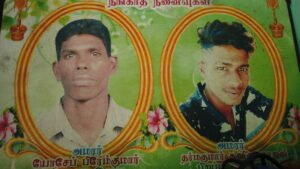
Joseph Premkumar (38), the husband of Premaranjini, who comes from a family with a long tradition of fishing, was the main pillar of their family. He was highly skilled in deep-sea fishing as well as catching sea leeches using deep-sea diving techniques. Whether on land or at sea, he was a great support to everyone who depended on him. Because of this, the villagers affectionately called him Kuddithambi.
On 23rd of February 2022, which was a Thursday, around 7:30 p.m., my husband and a younger brother by relation went to the sea. After that, on the 26th, my husband’s body washed ashore at Kevil Beach, while the younger brother’s body washed ashore at Aazhiyavalai.
Premaranjini states that the reason for becoming a woman-headed household is as mentioned above.
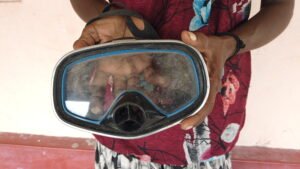
Premaranjini explained the skills of her husband and the reason why it was unlikely for him to accidentally drown in the sea: “He was an expert diver. He had trained extensively in swimming. He grew up without a father. Since the age of 12, he was accustomed to diving and swimming in the deep sea. Wherever he was left in the sea, he could swim to the shore. He did not know any other trade. Since he was 12, he had been trained only in the fishing profession. A person like him could not accidentally fall and die in the sea…”
In that case, one would have wanted to ask Premaranjini how Premkumar and the person who went to the sea with him actually died, and whether she knew the reasons behind it. However, without giving anyone the opportunity to ask that question, she herself was providing the answer.
“…During that period, there were frequent attacks by Indian trawlers in our sea. They would cut our nets and damage our boats. Because of this, our people suffered business losses worth several crores of rupees. During that time, there were many protests against Indian trawlers entering our territory illegally and fishing. He had also participated in some of those protests…”
Premaranjini often pauses, her voice faltering slightly and her eyes reflecting the weight of past memories. These moments of quiet introspection are common when someone who has lost the head of their family recalls experiences and memories associated with him. She, too, experiences these reflective pauses, allowing herself a brief respite as she recounts the past.
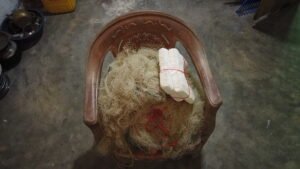
“I don’t know exactly what happened at sea. All the other boats of his companions returned safely. Only his fishing nets were recovered. The fishing nets had been cut in about four or five places. My elder brother could recognize the ‘colour’ of his fishing nets. Another day, when he went to the sea, he retrieved them. Even now, I keep those cut fishing nets as a memento of him. It seems suspicious that the fishing nets were cut. During that period, Indian boats used to come into these waters, cutting and damaging the boats and fishing nets of our people. So, it is only a guess that something might have happened that way…”
“…Hmm… at that time, the sea waves were very strong, so our boys who went into the sea to catch sea leech could not search for his boat by swimming. But later, those who did swim reported that the boat had broken into two pieces along with the hull. Moreover, neither the engine nor any of the items that were on the boat with him have been recovered from the sea even until now…”
Premaranjini’s words revealed evidence that seemed to link the cause of her husband’s death with the lawless activities of Indian fishermen who illegally operated within Tamil territories. However, she could not confirm it definitively. It seems as if the deep, secretive ocean, holding countless untold mysteries, has hidden this truth as well…
“…After the dead bodies washed ashore, couldn’t even see their two dead bodies. They had said it was not possible to bring the dead bodies home. Everyone knows the condition of a dead body that has been in the sea for three days. The children didn’t know the truth. They needed to know that their father had died. If not told, they would wait the whole day thinking that their father would return tomorrow. That’s why I argued and brought his dead body home myself. They were allowed only five minutes to bring the dead body inside the house.”
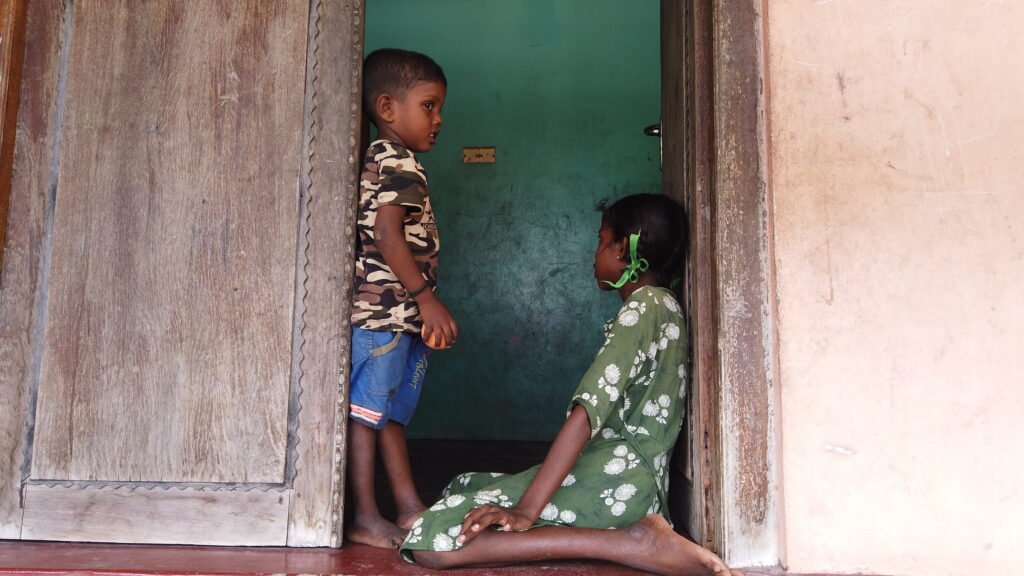
We never go to the sea on Fridays. On Thursday night, by twelve o’clock, we had finished our work and would usually return to the shore. He also said the same before he left that day. Trusting that he would come back at twelve, I went to the beach to wait for him. But even when the clock struck twelve, he didn’t return. Around twelve-thirty, I tried calling him, but he didn’t answer the call. Even the next day, Friday, he still had not returned home. “If he were alive, he would have definitely come ashore before twelve o’clock on Thursday night,” Premaranjini said, her voice trembling as she gently stroked the head of her younger son, who is still in preschool. Her eyes, marked with dried tears, stared blankly at the harsh, scorching sunlight burning outside the house. Footprints made by various people were scattered across the sand that covered her entire yard. Premaranjini might have been wondering whether her beloved husband’s footprints were also among them. The wind grew stronger; it was quickly blowing sand over the marks, filling them up and making them disappear.