The Story of Tamil-Brahmi/Tamili
Story and Picture | Vicky Kannan
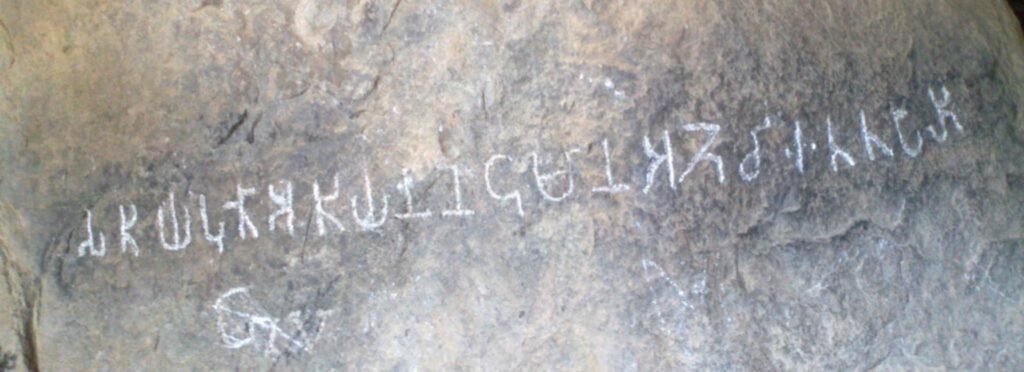
In 1882, Near Madurai in the Mangulam area, Robert Sewell first discovered the Brahmi inscription. At that time, no one realized that it was Tamil Brahmi. Later, in 1924, Subramania Iyer studied the inscription fully and stated that the language of the inscription was Tamili and that the script was Tamil-Brahmi. Historians at that time did not widely accept this view. However, they did accept that this inscription was a form of writing different from Ashoka Brahmi.
Cave inscriptions greatly help us understand the ancient written forms of the Tamil language. There are two different views regarding the naming of the script found in these inscriptions. Some refer to it as Tamili, while others call it Tamil-Brahmi.
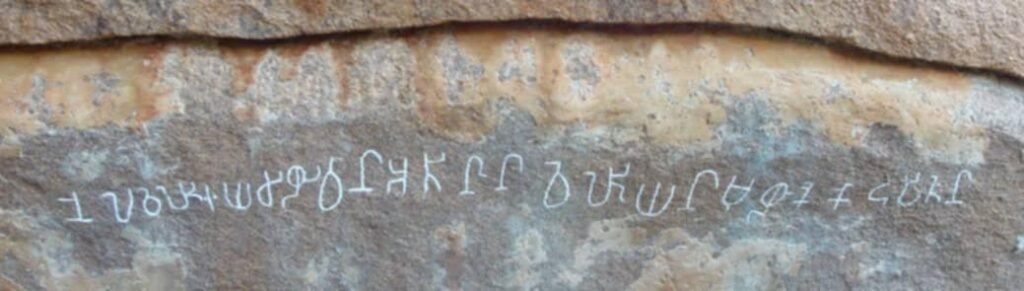
In northern India, Emperor Ashoka ruled during the 3rd century BCE. The Brahmi script was in use there during his reign. The cave inscriptions found in Tamil Nadu are also known to belong to the same period. There are some similarities between the script forms found in these cave inscriptions and the Brahmi script used in northern India. Because of this, some scholars say that both scripts developed from a common Brahmi base forming the cave inscription script in Tamil Nadu and the Brahmi script in the north. Based on this view, the terms Northern Brahmi and Southern Brahmi are also used. The Tamil Nadu epigraphist Iravatham Mahadevan referred to the cave-inscription script forms as Tamil-Brahmi.
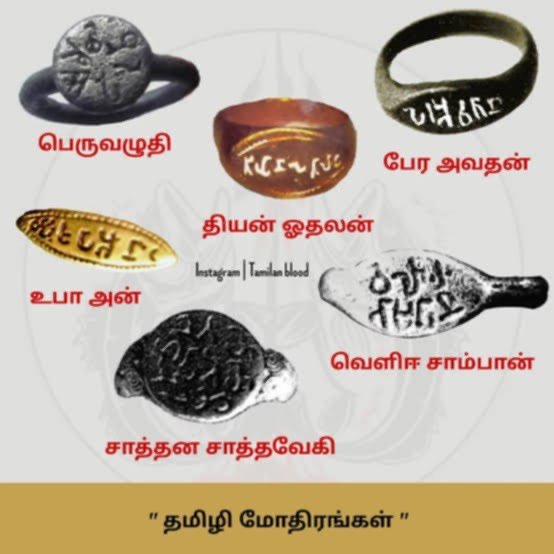
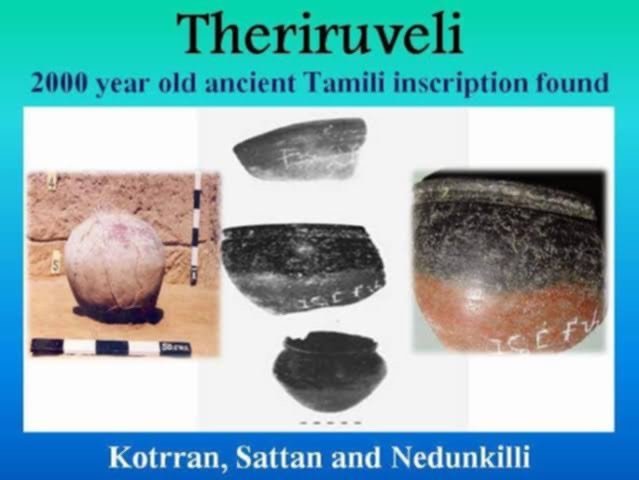
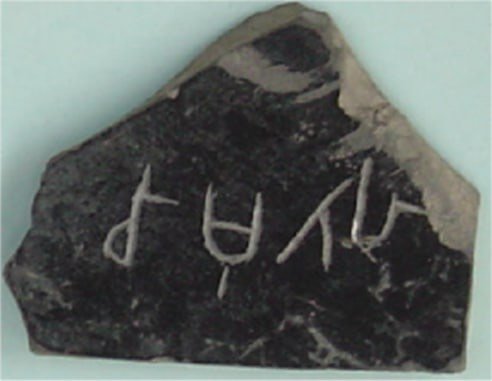
Among the alphabetical scripts of India, the oldest is the Brahmi script. Based on regional variations, it has been classified into different types such as Tamil-Brahmi/Tamili, Ashoka Brahmi, North Indian Brahmi, South Indian Brahmi, and Sinhala Brahmi. The scripts used in India today have all developed from the Brahmi script. Moreover, Tamil-Brahmi/Tamili inscriptions have been found on pottery sherds discovered through excavations and field studies, as well as on coins, seals, and rings collected from riverbeds.
The cave inscription script of Tamil Nadu differs from the North Indian Brahmi script in several aspects. These differences reflect the unique characteristics of the Tamil language. In many respects, Tamil-Brahmi appears distinct from Ashoka Brahmi. For example, unlike Ashoka Brahmi, Tamil-Brahmi had a specific method to separate pure consonants from consonant-vowel combinations. Moreover, according to Iravatham Mahadevan, early Tamil-Brahmi used slightly different diacritical marks to indicate vowel sounds in consonant–vowel combinations. In addition, there were extra letters to represent sounds that exist in Tamil but not in Sanskrit, and letters for sounds found in Sanskrit but unnecessary for Tamil were absent. For example, aspirated consonants are not seen in Tamil-Brahmi.
In the inscriptions dating to after the 2nd century BCE, a slightly different form of Tamil-Brahmi is seen. This form closely resembles the Tamil writing system described in the Tholkappiyam. Notably, dots were used to distinguish consonants from vowel-indicated consonants. After this stage, Tamil letters evolved into forms with curved strokes.
Considering this distinction, epigraphist Nagasami states that using Tamili as a proper name is more appropriate. He illustrates his view by citing two clear pieces of evidence.
In the Samavayanga Sutra, dating back to the 1st century BCE, a list of 18 types of letters is provided, and among them is one called Tamili. Speakers of Prakrit referred to Tamil letters as Tamili and Dravidi. The term Dravidi is a later name, appearing in the Lalitavistara, a text believed to belong to the 5th–6th centuries CE. Therefore, we shall refer to the cave inscription letters as Tamili.
Tamil–Brahmi/Tamili inscriptions are found widely throughout nearly all of Tamil Nadu. In some parts of Kerala and Andhra Pradesh, due to maritime trade connections, a few pottery sherds and a touchstone with personal names have recently been discovered in places such as Egypt, Thailand, Oman, Sri Lanka, and Africa.Tamil-Brahmi/Tamili inscriptions are classified as Early Tamil-Brahmi and Later Tamil-Brahmi, covering the period from the 6th century BCE to the 4th century CE.
Initially, researchers like Iravatham Mahadevan believed that the Tamil-Brahmi script reached Tamil Nadu through Jain monks who travelled from the north to the south. The reason for this is that all the caves where Tamil-Brahmi inscriptions are found also contain sculpted images of Jain Tirthankaras, and in Jain texts, there is mention of a woman named Brahmi, the daughter of Lord Adhinath.
These have been presented as evidence supporting this view. Epigraphists like Rajavelu have challenged this view in both speech and writing. Their argument is that, outside Tamil Nadu, no Tamil-Brahmi inscriptions are found in caves. Notably, none have been discovered in Karnataka, which is said to have been settled by Jains. However, this long-standing debate was settled by the recent Keeladi excavation report. By scientifically dating Tamil to as early as the 6th century BCE, debates regarding Jain connections were rendered irrelevant. Moreover, in recent years, various excavations in Tamil Nadu have continuously uncovered pottery sherds bearing Tamil-Brahmi inscriptions. Professors like K. Rajan have written that the highest number of such inscribed pottery sherds was found in the Kodumanal excavation in Tamil Nadu.