
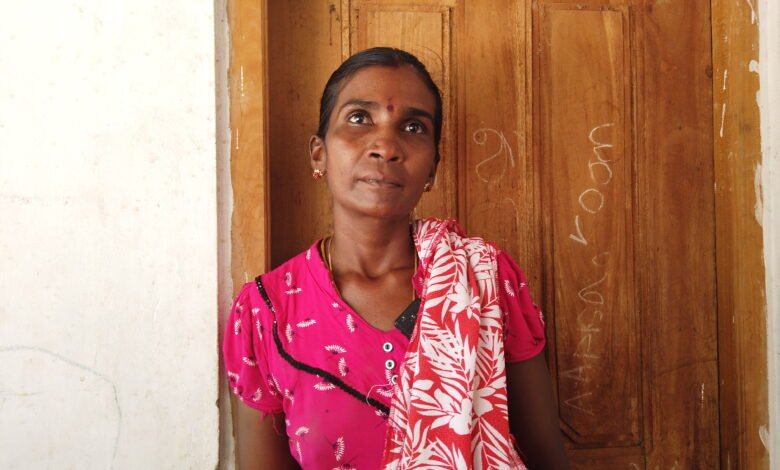
Sumathi: The Woman Who Never Gives Up Hope
Story and Picture | North East Narrative
It is often said that war affects children first and women next. The Vanni region of Sri Lanka’s Northern Province stands as powerful evidence of this truth. While many women continue to live unable to recover from the impacts of war, there are also those who tirelessly strive to rise above their struggles. They are fighting a great battle—economically and socially—to elevate their lives. Among those who refuse to give up and continue their relentless struggle is Anton Johnson Sumathi, who lives in Selvanagar, Naddankandal village.
I shell peanuts for others. Vennila Production Centre is the name of my small enterprise. Mostly, I shell peanuts for customers. In addition, I shell peanuts for making peanut halwa. I used to prepare peanut halwa as well. But since I don’t have enough workers to run the operation smoothly, I have currently stopped the production. For sowing, I shell the peanuts. I charge fifty rupees per kilogram,” says Sumathi, who owns a small device for shelling peanuts. When she says “machine,” it is not a fuel-powered, noisy machine. It is a simple, locally made device operated by human effort. The unshelled peanuts are placed inside it, and by turning the handle manually, the shells are removed. Afterwards, the peanuts are placed in a winnowing basket and shaken so that the remaining husk is separated, leaving clean peanuts.
I am a differently-abled person. While relocating, I was injured in Mullivaikkal. I have shrapnel fragments in my head and leg. Sometimes it hurts. If I stand in the sun for a long time, I feel dizzy. I get angry and sometimes quarrel with my children. But despite all that, I push myself forward,” says the person, who still carries the pain from the past. Although she physically feels that pain, she does not allow her heart to express it in sorrowful words. Her faith stands above everything else.
A company provided me with this machine and also trained me on how to shell peanuts. I have been doing this work for the past five years. The machine has broken down twice, but I repaired it. When asked whether this work is profitable, Sumathi said, “At first, I charged only twenty rupees per kilogram. Now I charge fifty rupees. The work is not consistent. Some days I shell peanuts worth two thousand rupees.” As she spoke, a light of hope shone in her eyes.
“I not only shell peanuts but also plant them. My leg doesn’t move very well. If I ride a bicycle, the pain in my leg becomes severe. I used to wear stacked shoes (for people whose legs have been amputated and reattached, the legs are shorter; to balance both legs, two or three shoes are layered and glued together to make up the height). Now I don’t wear them anymore,” she says, her eyes welling up. But I do all kinds of work. I have two cows, and I am the one who feeds and tends to them,” she says. The shrapnel fragments lodged in her head and leg could theoretically be removed through surgery. When asked why she hasn’t done it, she immediately replies, “Removing them would be life-threatening. I have three children. That’s why I won’t undergo the surgery.
My husband has wheezing problems. He survives by using a inhaler. He cannot do heavy work. We also have to cover the educational expenses of our three children. If I want to go to the clinic, I have to travel from here to Mancholai Hospital, which costs two thousand rupees. I use that money to pay for my children’s private tuition. Peanut shelling work is not daily; it only occurs during a particular season. When there is no work, I do daily wage labour. I go to work early in the morning and return around eleven o’clock. If the sun is strong, my head starts to ache. Then I get angry. Because of this problem, sometimes I am unable to even attend school meetings.
We don’t tell anyone about our hardships. The government does not provide any help for the injuries. We survive solely through our own hard work. Our children go to school riding someone else’s bicycle.
My father went missing when I was just five years old. He went to Vavuniya and never returned. We are three sisters. Our mother worked hard to raise us. I have studied only up to grade ten. I want to at least educate my children,” says Sumathi, who carries a great deal of hope. The strength of her body and mind, and the burden of the struggles she has endured, are even greater than that hope.