Hill country: Displacement in the Name of Disaster
Story | Arul karki | Picture | North East Narrative
Although the Hill country Tamil community of Sri Lanka has served as the backbone of the nation’s economy for more than two centuries, today it faces the risk of a new form of political displacement under the guise of climate change. In recent months, calls have intensified to resettle the hill country people from their ancestral lands to the North and Eastern Provinces, citing the damage caused by the Ditwah cyclone, which struck in November 2025. Although these proposals are presented under the guise of disaster mitigation, they represent a serious flawed argument that undermines the hill country people’s political power, national identity, and land rights.
Erosion of Land Rights and Political Power
The political strength of a community is rooted in the geographical core where it lives in concentration. Through major struggles in the past, the hill country people have secured their own political representation and local government authority. In particular, the Pradeshiya Sabha (Amendment) Act of 2018 brought plantation settlements under the jurisdiction of Pradeshiya Sabhas, thereby granting these people a formal and legal political recognition over the land on which they live.
Forcing these people to relocate to the North and East would undermine the political representation they have fought for over generations, reduce them to a minority in a new environment, and weaken their collective bargaining power. This is not “resettlement”; rather, it amounts to the dispossession of a national community from its political core.
Administrative Failure and Planned Displacement
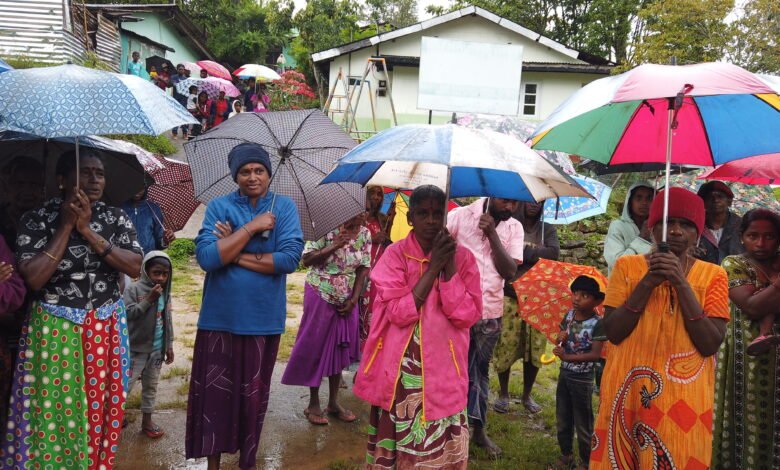
The deaths of 232 people in Kandy and 89 in Nuwara Eliya during the Ditwah disaster were not caused by the geography of the hill country. Rather, they resulted from the lack of integration of local infrastructure within the national governance framework. Even after the 2018 legislative amendment, the government has failed to establish proper roads, drainage systems (WASH), and landslide-prevention walls within the estates. Relocating people to the North and East to cover up this administrative failure is an act by which the government shirks its own responsibility.
If the Pradeshiya Sabhas, the Urban Development Authority (UDA), and the New Villages Development Authority for Plantation Region had worked in coordination, these people could have been kept safe on the land where they live. The cause of the disaster-related deaths was confining people to lands without secure tenure, not the land itself.
Erosion of Nationhood and Identity
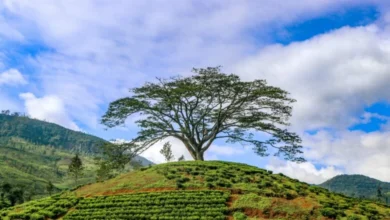
The hill country nation is deeply rooted in the tea-covered hills and the culture they have built there. Using climate change as a pretext to uproot them would destroy their unique identity. As highlighted by research from the Earth Journalism Network, climate-induced migration has already pushed hill country women into urban slum settlements, exposing them to exploitation and deprivation. In this context, a planned relocation would further increase social insecurity.
The Right to Stay on Their Land
The government’s responsibility is not to displace people, but rather to ensure their safety on the land where they live.
Infrastructure Coordination: Under the 2018 Act, Pradeshiya Sabhas should allocate funds for estate infrastructure and transform the safe areas of the hill country into secure residential zones.
Full Land Ownership: The labour lines should be removed, and housing schemes with absolute land deeds should be provided in safe zones within the same areas.
Political Security: National Disaster Management Plans (NDMP) should be implemented within the geographical boundaries of the hill country without undermining the political authority of its people.
The displacement of the hill country people is not a geographically driven solution; it is a major political setback. Using the Ditwah disaster as a pretext to push them toward the North and East would simultaneously destroy their political aspirations and land rights. Reconstruction is not about displacing people; it is about protecting them on the land they rightfully inhabit. The government must remove its administrative barriers and ensure the land rights and political sovereignty of the hill country people within their geographical core.