Climate Justice in Sri Lanka: A Climate Statement from a Debtor Nation
Article | ArulKarki | Picture | North East Narrative
At a time when Sri Lanka is facing the worst economic crisis in its history, it has also been internationally recognized as one of the countries most vulnerable to the impacts of climate change. According to the Germanwatch Climate Risk Index, Sri Lanka is identified as one of the most high-risk countries in the world, mainly due to its geographical location and the structural weaknesses of its economy. With more than 38 percent of the total workforce engaged in agriculture and hundreds of thousands of people depending on fisheries along the country’s 1,340-kilometre coastline, climate change has emerged not merely as an environmental issue, but as a major factor obstructing Sri Lanka’s economic recovery. The greatest contradiction lies in the fact that Sri Lanka, which contributes less than 0.1 percent to global carbon emissions, is nevertheless being forced to bear the severe losses resulting from their consequences.
According to official government reports, particularly the Third National Communication (TNC), extreme weather events such as floods, landslides, and droughts have increased in Sri Lanka over the past decade at an unprecedented rate. Compared to the period from 1961 to 1990, the average temperature has risen by 0.16 degrees Celsius, alongside significant changes in rainfall patterns. In particular, in mountainous regions such as Nuwara Eliya, rising minimum temperatures and intense rainfall over short periods have resulted in significant economic losses. With the average annual economic losses caused by disasters in Sri Lanka estimated at hundreds of millions of dollars, this has a significant impact on the country’s Gross Domestic Product (GDP) and further destabilizes an economy that is already in decline.
Climate justice refers to ensuring that those most affected by climate change receive adequate protection and compensation. However, in the case of Sri Lanka, the situation is entirely reversed. Developed countries became wealthy by emitting large amounts of carbon through their industrial revolutions, while the resulting storms and floods devastate the infrastructure of countries like Sri Lanka. To rebuild destroyed roads, bridges, and reservoirs, countries like Sri Lanka are compelled to borrow once again from international banks at interest. A nation already burdened by debt is thus forced to take on new loans for damages it did not cause, creating a “Debt–Climate Trap” that pushes the country into an inescapable cycle of indebtedness.
Economic Crisis and Climate Shocks
Sri Lanka’s current economic crisis has not arisen solely from financial mismanagement; it is closely linked to the continuous “economic shocks” caused by climate change. A island nation like Sri Lanka has relied heavily on agriculture, plantation crops, and tourism for its foreign exchange earnings and national income. It is noteworthy that all three of these sectors are highly climate-sensitive. Over the past few decades, rising temperatures and erratic rainfall in Sri Lanka have significantly reduced the country’s production capacity.
For example, Sri Lanka’s tea and rubber productions are major sources of foreign exchange earnings. Due to climate change, severe droughts or excessive rainfall reduce the yields of these crops, thereby disrupting the country’s export revenues. When revenues decline, the government is compelled to repeatedly borrow from abroad to meet import needs and essential goods. This directly affects a country’s “debt sustainability.” When a nation is pushed into a situation where it cannot repay its debts, it evolves into a major economic crisis.
The funds spent on reconstruction work following disasters further intensify Sri Lanka’s economic crisis. When a major flood or landslide occurs, the government has to spend billions of rupees to repair damaged roads, bridges, and electrical infrastructure. These funds are often originally allocated for development projects. In this way, by diverting money meant for development to disaster recovery, the pace of the country’s economic growth is hindered. This becomes a form of “climate injustice,” where countries like Sri Lanka sacrifice their economic development, while developed nations profit from carbon emissions.
Furthermore, inflation and the rising prices of essential goods caused by the economic crisis severely impact farmers and fishermen whose livelihoods are already threatened by climate change. A farmer facing crop losses due to drought must also bear the simultaneous burden of increased costs for fertilizers and fuel caused by the economic crisis. This not only increases rural poverty but also pushes people into risky debt burdens such as microfinance. Therefore, Sri Lanka’s economic recovery cannot be achieved merely through debt restructuring; it also depends on building a “Climate-Resilient Economic structure” that can withstand climate change and securing grants and support from the international community.
Sectoral Impacts in Sri Lanka
Sri Lanka’s economy and the daily livelihoods of its people are closely linked to nature and the climate. As a result, even minor changes caused by climate change can cause significant declines in the country’s overall production capacity. According to official data, the following sectors face the highest levels of vulnerability:
1. Agriculture Sector
More than 38 percent of Sri Lanka’s total workforce is engaged in agriculture, either directly or indirectly. In particular, paddy cultivation in dry zones and plantation crops (tea and Rubber) in wet zones are highly vulnerable toclimate conditions.
Paddy Cultivation: Studies warn that if the temperature rises by 2 degrees Celsius, the country’s rice yields could decline by approximately 10%–20%. Erratic rainfall disrupts the ‘Yala’ and ‘Maha’ cropping seasons, and droughts can leave fields abandoned.
Plantation Sector: Tea cultivation yields optimally only within a specific temperature range. Rising temperatures reduce the quality of tea leaves and create conditions for the spread of new pests and diseases in tea plants. This directly impacts Sri Lanka’s export revenues.
2.Fisheries and Coastal Management
Sri Lanka has a coastline stretching 1,340 kilometers, and a significant portion of the population relies on the sea for both proteins needs and income.
Sea Level Rise: By 2050, rising sea levels are expected to put coastal cities such as Colombo, Negombo, Kalutara, and Jaffna at risk of flooding. This damages coastal fishing infrastructure, including fishery harbours and boats.
Displacement of Fish Stocks: Rising sea temperatures disrupt the reproductive cycles of fish and cause deep-sea fish to migrate to other areas. As a result, small-scale fishers are unable to access these offshore resources and lose their income.
3.Water Resources
One of the greatest pressures of climate change falls on water resources. Even if the overall rainfall does not decrease, its irregular distribution creates significant challenges.
Drinking Water Shortages: In dry zones, declining groundwater levels intensify shortages of potable water.
Irrigation Challenges: Traditional irrigation systems, such as the ‘Ellangawa’ cascade tanks, dry up during droughts, preventing the uninterrupted supply of water needed for cultivation.
4. Public Health
Climate change creates conditions that are conducive to the spread of diseases.
Infectious Diseases: Rising temperatures and flooding contribute to an increase in mosquito-borne diseases such as dengue and malaria. Additionally, shortages of clean drinking water lead to a rise in waterborne diseases, such as diarrhea.
Heat Impact: Due to rising temperatures, workers who labour outdoors—such as farmers and construction workers—are at risk of adverse health effects.
5. Tourism Sector
The tourism sector, which plays a key role in generating foreign exchange for Sri Lanka, relies heavily on the country’s natural beauty.
Loss of Biodiversity: Rising sea temperatures cause coral reefs to bleach, which negatively impacts Sri Lanka’s marine-based tourism industry.
Infrastructure Damage: Coastal hotels and beaches are being eroded by the sea, causing long-term economic losses to the tourism sector.
All of these sectoral impacts are interconnected. A decline in agriculture affects food security while simultaneously undermining the livelihoods of coastal fishers. Therefore, Sri Lanka’s economic restructuring must focus on “climate adaptation” programs that rebuild these sectors. For such large-scale initiatives, grants provided by developed countries, based on historical responsibility, are a more just solution than loans.
District-wise Climate Impacts
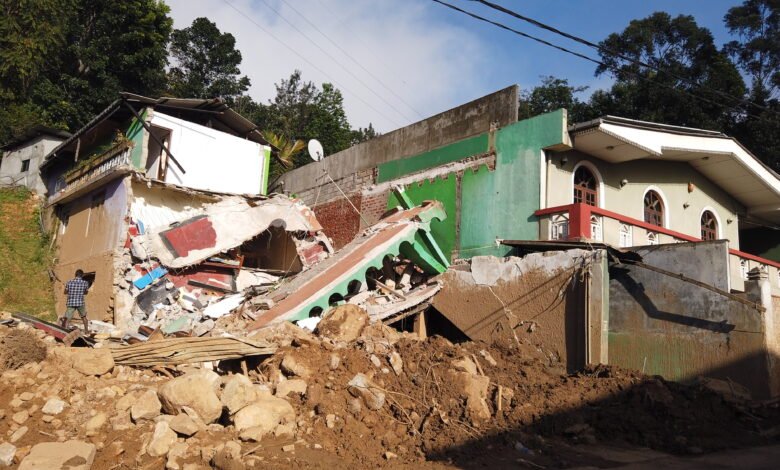
Sri Lanka’s geographical diversity varies from district to district, so the effects of climate change manifest differently according to each region’s terrain and livelihoods. In particular, districts in the central highlands—such as Badulla, Nuwara Eliya, Ratnapura, and Kegalle—have faced unprecedented landslide risks over the past few decades. According to Sri Lanka’s disaster management data, landslide-prone areas have increased approximately 22-fold over the past decade, representing a major concern. In districts like Nuwara Eliya, rising temperatures affect tea cultivation, while sudden, heavy rainfall triggers landslides that completely destroy plantation workers’ residences. These disasters force the government to repeatedly borrow funds to provide new land for displaced people and to rebuild infrastructure, creating a vicious cycle of debt.
Dry-zone districts such as Anuradhapura, Polonnaruwa, Ampara, and Kurunegala are severely affected by extreme drought. In these areas, rainfall patterns have changed completely, disrupting the traditional cropping seasons of farmers. Specifically, due to drought, the ‘Yala’ cropping season is completely abandoned in many districts, putting the country’s food security at risk. The resulting water scarcity in these districts has also created a form of social injustice: women must walk miles to fetch drinking water, and farmers are pushed into poverty because they cannot repay agricultural loans. These vulnerable farmers are, in effect, paying the price of carbon emissions from developed countries through the loss of their livelihoods—a stark manifestation of climate injustice.
Coastal districts such as Jaffna, Kilinochchi, Mullaitivu, and Batticaloa are facing unique challenges including sea-level rise and saline intrusion. In particular, in the Jaffna Peninsula, the intrusion of seawater into groundwater has caused freshwater wells and agricultural lands to become saline, rendering them unfit for use. This poses the risk of creating a severe drinking water crisis and large-scale displacement in the peninsula in the future. At the same time, fishermen in the Mannar and Mullaitivu districts are repeatedly unable to go to sea due to rough sea conditions and storm warnings, resulting in the loss of their livelihoods. When fishing equipment and harbour facilities are damaged, fishing communities are forced to fall back into the burden of high-interest loans such as microfinance to repair and replace them, which is a deeply distressing situation.
Highly populated districts in the Western Province, such as Colombo, Gampaha, and Kalutara, frequently experience flash floods due to unplanned urbanization and increased rainfall. These urban floods not only cause damage to infrastructure but also create conditions conducive to the spread of infectious diseases such as dengue. As a result, additional financial pressure is placed on the public health system, while low-income communities lose their small livelihoods and are pushed further into economic hardship. In this way, every district in Sri Lanka is facing a climate crisis akin to a battlefield, shaped by its own geographical characteristics. Therefore, during national-level debt restructuring, it is imperative to apply international pressure to ensure that the financing required for district-level recovery is obtained not as loans, but as substantial grants.
Under Sri Lanka’s current financial circumstances, taking on additional debt would be tantamount to economic suicide. Therefore, a core principle of climate justice is that “climate finance” must be provided not in the form of loans, but as full grants. It is estimated that approximately USD 26.5 billion will be required to meet Sri Lanka’s Nationally Determined Contributions (NDCs) by 2030. There is an urgent need for an international policy shift toward “Debt-for-Climate Swaps,” whereby a portion of Sri Lanka’s external debt is cancelled and redirected toward climate adaptation projects—such as landslide protection structures, drainage systems, and the upgrading of traditional irrigation methods. By explicitly foregrounding climate impacts as a key consideration in debt-restructuring negotiations, Sri Lanka can compel recognition of the historical responsibility of developed countries.
Climate injustice creates deep inequalities not only at the national level but also within communities. In particular, women in coastal and rural communities experience a unique burden as a result of climate change. Similarly, variations in rainfall patterns disrupt the cropping seasons of small-scale farmers, exposing them to repeated losses and mounting rural debt. This clearly demonstrates that disasters are not merely statistics, but issues fundamentally linked to human rights and social justice.
Sri Lanka’s ancient irrigation systems—such as the cascade systems of tanks and canals—stand as strong historical evidence of effective drought adaptation. However, due to the prioritization of modern “hard engineering” solutions, such traditional, land-appropriate knowledge systems are often neglected. This constitutes a form of epistemic injustice. Foreign financial assistance should not be limited solely to concrete-based construction projects, but should also be directed toward promoting locally suitable, low-cost, and nature-based solutions. Such initiatives not only safeguard local livelihoods but also help maintain long-term ecological balance.
Women and Climate Justice
Although climate change is a global natural phenomenon, its impacts differ significantly along gender lines. In Sri Lanka, where women constitute more than 51.5 percent of the total population, they experience the burdens of climate change in unique and severe ways. In particular, traditional gender roles prevalent in rural and coastal fishing communities place women at greater risk and vulnerability during periods of climate crisis. Because responsibilities for household food security and water management are largely placed on women, their workload increases manifold during periods of drought or flooding. For example, according to climate justice reports, when water sources dry up, women are often forced to walk several miles to collect drinking water, directly affecting their health as well as the time available for childcare.
Social justice is meant to provide equal opportunity and protection for all, yet climate change is deepening existing social inequalities in Sri Lanka. In particular, woman-headed households face significant economic challenges in recovering from disasters. When disaster relief and adaptation plans are designed, women’s voices are often excluded from decision-making processes. This constitutes a form of policy injustice. Women engaged in self-employment activities such as repairing fishing nets or processing fish are not provided with suitable alternative income opportunities or insurance schemes when climate change disrupts their livelihoods. As a result, they are pushed back into poverty and become trapped in debt obligations from microfinance institutions.
Women’s adaptation strategies to climate change are both unique and deserving of recognition. For decades, women who have closely observed the local climate in their regions possess traditional knowledge about when to cultivate specific crops or how to manage water efficiently. However, such knowledge-based contributions are often overlooked in modern scientific planning and projects. Women should not be seen merely as “victims” but recognized as agents of change in addressing climate change. To ensure social justice, climate finance must be provided as direct grants to small enterprises led by women.
To establish climate justice in Sri Lanka, gender-sensitive policies are essential. By ensuring equal priority for women in land rights, financial assistance, and technical training, it is possible to build a resilient and empowered society. Climate finance provided by developed countries should primarily aim to safeguard the livelihoods of marginalized women in Sri Lanka and guarantee them access to essential health and education services. Any climate solution that ignores women’s rights and social justice will fall short of achieving true success. Therefore, securing women’s participation and rights is an urgent necessity for an economically and socially just recovery.
International Policies and Sri Lanka
Sri Lanka has been actively participating in international efforts to address climate change. In particular, it has ratified the United Nations Framework Convention on Climate Change (UNFCCC) and the Paris Agreement, and has been regularly updating its Nationally Determined Contributions (NDCs) in line with these commitments. Under its current policy stance, Sri Lanka has set mitigation targets for 2030 to reduce carbon emissions across six key sectors: electricity generation, transportation, small-scale industries, waste management, agriculture, and forestry. However, the harsh reality is that Sri Lanka does not have sufficient financial and technological resources to achieve these ambitious targets. According to the country’s official assessment (Third National Communication), more than USD 26 billion is required to meet these goals. For a nation already burdened with heavy debt, mobilizing such a large sum through international assistance today has become a matter of global debate.
In international climate negotiations, Sri Lanka’s main argument is based on “Common But Differentiated Responsibilities (CBDR).” This means that historically wealthy countries, which have contributed most to global warming, should provide compensation to poorer nations like Sri Lanka that are now bearing the brunt of its impacts. Recently, at international climate conferences held in Egypt and Dubai (COP27 & COP28), the establishment of a “Loss and Damage Fund” to address the financial needs arising from climate-induced disasters was recognized, providing a hopeful development for Sri Lanka. However, Sri Lanka must remain firm that any funding received from this mechanism should come as full grants, not loans. Taking on repeated loans to address damages caused by climate change would undermine a nation’s economic sovereignty. Therefore, it is essential for Sri Lanka to make climate finance a central condition in debt-restructuring negotiations.
Sri Lanka’s domestic policy planning is currently being aligned with the Sustainable Development Goals (SDGs). Frameworks such as the National Climate Change Policy (2023) and the National Environmental Action Plan (2022–2030) serve as guides for the country’s future trajectory. However, these policies often remain paper-based plans, facing challenges in reaching grassroots communities. In particular, when policy decisions made at the national level are implemented at provincial and local council levels, insufficient budget allocations often stall their execution. Climate justice is not merely an international policy concept; it is a fundamental right that must reach rural farmers and coastal fishers. Therefore, Sri Lanka’s financial management systems must be transparently restructured to ensure that grants received internationally are delivered directly to the communities affected.
No matter how strong international policies and legal frameworks are, it is essential for Sri Lanka to adopt a position that reflects its unique geographical and economic realities. The country should integrate its ancient irrigation and agricultural technologies (Indigenous Knowledge) as a central component of modern climate strategies. This provides an opportunity to showcase land-appropriate solutions to the world, in contrast to the technological dominance of developed countries. At the same time, by persistently leveraging international pressure to convert debt into grants for climate adaptation (Debt-for-Climate Swaps), Sri Lanka can simultaneously secure its economic sovereignty and environmental protection.
Recovery and the way to forward
Sri Lanka’s current economic decline and climate crisis have become inseparable, dual challenges. The various data and social realities examined in this article highlight that climate change in Sri Lanka is not merely an environmental issue; it is a livelihood struggle intertwined with the country’s economic sovereignty and social justice. The billions of dollars required to achieve the ambitious climate targets Sri Lanka has set for 2030 cannot be mobilized by a nation already burdened with heavy debt. Therefore, during international debt-restructuring negotiations, it is imperative for Sri Lanka to firmly advance the demand for climate justice. It is unjust for countries like Sri Lanka to take on additional interest-bearing debt to address natural shocks caused by the historical misdeeds of developed nations. Such a practice must end, and foreign debts should instead be converted into grants for climate adaptation.
The district- and sector-specific impacts we have observed underscore the need for Sri Lanka’s policymakers to recognize the importance of decentralized adaptation strategies. The drought in Anuradhapura, the drinking water crisis in Colombo, and the landslide risks in Nuwara Eliya each demand distinct, localized solutions.
Finally, the future of the island of Sri Lanka rests on the integration of economic recovery and environmental protection. The international community must recognize countries like Sri Lanka not merely as “debtors,” but as stakeholders confronting the impacts of global climate change. International mechanisms, such as the Loss and Damage Fund, can help establish a just global order by ensuring debt-free financial assistance reaches Sri Lanka. Converting debts into grants is not a concession to Sri Lanka; it is a global moral responsibility. True success lies in leaving our fertile land, rich biodiversity, and the dignified lives of our people to future generations as a debt-free nation.