
A Country Known for Injustice
Story and Picture | North East Narrative
Kumarapuram is a village situated along Batticaloa Road within the Muthur Divisional Secretariat Division of the Trincomalee District, in Sri Lanka’s Eastern Province. This village, inhabited by Tamils for many generations, is surrounded by extensive paddy fields and water bodies, upon which the local economy is entirely dependent. On 11th of February 1996, the village endured a grave tragedy. A large-scale massacre was carried out by personnel of the Sri Lankan armed forces in collaboration with paramilitary groups. During the indiscriminate shooting, 26 civilians including children and pregnant women were killed, and 24 others sustained injuries.
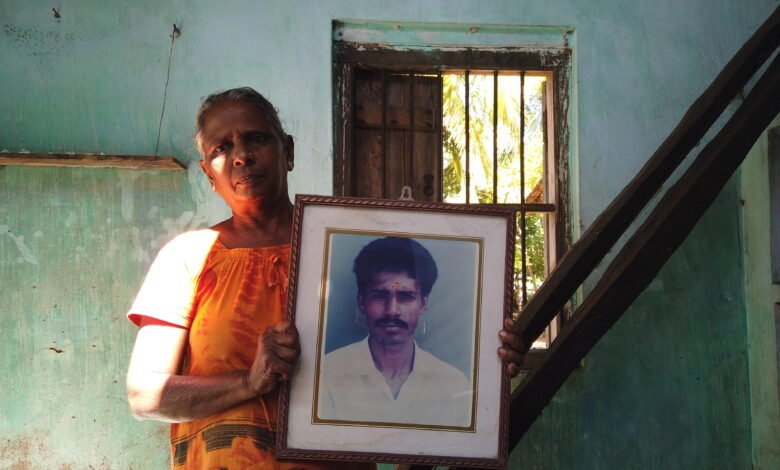
Nadarasa Thavamani (69), who currently resides in Kumarapuram, is a direct eyewitness to the massacre. Since her husband, Nadarasa, was killed during the incident, Thavamani has been living alone with her son.
“We got married in 1995. We lived together for only eight months. From the moment I became pregnant, my life turned into misery,” Thavamani introduces herself this way.
On 11th of February 1996. We were inside the house. We heard a lot of explosions on the road. Out of fear, we stayed inside. Many members of the Srilankan army had entered the village. Something had happened somewhere, it seems, so the army from Thekkavaththai, Ambaththeddu, and Kiliveddy all came into our village and began shooting.
When they broke the door and fired, my husband was shot in the stomach. When they fired through the window, the woman there was shot in the forehead.
In that house, they had shot seven people. Among them, two were pregnant women who died. One of those women was due to give birth on the 16th. She was shot on the 11th.
They didn’t take anyone outside and shoot. They shot everyone while keeping them inside the house.
From around 5 pm in the evening until 8pm at night, the whole place was filled with gunfire. No one could come outside. Only when dawn broke did we realise that not only our house, but every house had faced the same horror. A young girl there had also been raped and killed.
It was the white officers who first said not to take the dead bodies. Later, they took the dead bodies to Muthur and kept them there. On Wednesday did we bury the bodies.
Among them, 26 people were shot dead and 24 were injured. Not only the people from here, but people from Kiliveddy, Ambatheddu, and Menkamam who had come into our village also died. They shot and killed everyone — including small children and pregnant women.
At first, the case was heard in Muthur. Later, it was transferred to Trincomalee. Even there, the case was heard nineteen times, but there was no conclusion. After that, it was moved to Anuradhapura, and we went there as well. Even there, we did not receive any kind of decision. Until now, there has been no resolution. Every year, we continue to hold the remembrance event. Everyone comes on the Remembrance Day. We keep asking all those who come to give us justice for this. That is why, despite all the difficulties, we continue to hold the Remembrance Day every year.
Arasaradnam Nagarasa (74), one of the survivors who escaped with severe injuries during the massacre, lives in the same village where Thavamani resides. Though he is visually impaired, he too carries painful memories of that time.
On 11th of February 1996, fourteen of us had gone to work as labourers to harvest paddy. Around 3 p.m., our work was almost over. Just as we were about to leave to bathe, we heard the sound of gunfire. At first, I thought it was the army firing into the air to scare away birds like herons and cranes. But that day, the sound of gunfire was much louder.
I ran back to my house. Others also ran back to their homes. Even after reaching home, we could hear gunfire all around the village. At that moment, people were running towards our house as well.
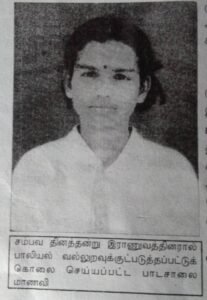
Suddenly, I felt something like raindrops fall on my cheek. At that moment, my eye had come out. My son held on to me, but I did not lose consciousness. They had gone past me. Every house was filled with gunfire. There were dead bodies and injured people everywhere. When we looked around, there wasn’t a single person left alive. No one could come to help. They didn’t allow anyone to enter.
As they carried me away after finding me, my wife was also shot in the stomach by gunfire. My son was shot in the leg as well. He needed twenty-six stitches. He was only eight years old at that time.
The next day, around 7:00 a.m., they took us by bus to hospital. In Trincomalee, they injected something near this eye. The swelling is still there. Then I was admitted to Kandy hospital for thirteen days. After that, I was admitted to Trincomalee hospital for seven days. I realized that I had lost the vision in my eye. The other eye also doesn’t see clearly. Three years have passed like this.
In the meantime, all the people who were injured here were taken to court and asked to identify members of the Sri Lankan Army. Eight of them were identified. Their cases are still ongoing. I do not know anything about what is happening with my own case. I have not received any summons. The policeman in Kandy who recorded my oral statement did not take it properly. He said he would return after gathering the necessary information to record it again, but he never came back. My statement was not recorded in Trincomalee either.
The case was transferred from Muthur to Trincomalee and Anuradhapura, yet no verdict has been issued in our favour; it was dismissed outright.
People have suffered immensely, wandering in despair because of this injustice. Who will ensure that justice is served?
The people are exhausted and disillusioned. “Who will give us justice?” is the question that haunts Nagarasa, who continues to suffer from vision loss.
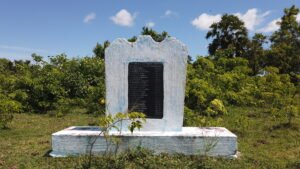
Note on the Legal Proceedings: Initial investigations began in the Muthur and Trincomalee courts. However, in 2013, the case was transferred to the Anuradhapura High Court, citing the war environment and the safety of the suspects. On July 27, 2016, the court ruled that there was insufficient evidence to convict the accused. Consequently, six members of the Sri Lankan Army, who had been previously identified by witnesses, were acquitted and released.