
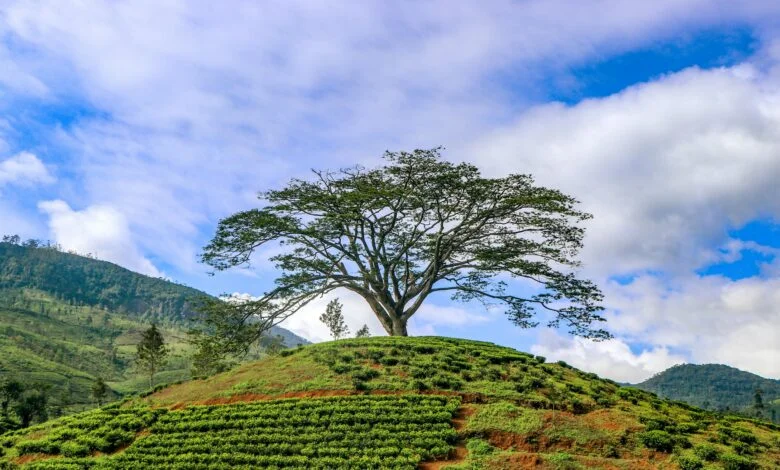
Article | Arul Karki | Picture | Anas Mohamed Nuski
Sri Lanka’s tea industry, which stands as a main pillar of the national economy, is today facing unprecedented challenges due to global warming and climate change. Established in the 19th century, the Ceylon Tea trade now supports the livelihoods of over 1.5 million people and plays a vital role in earning foreign exchange for the country. However, the rising extreme temperatures, irregular rainfall patterns, and the increasing frequency of natural disasters in recent times are not only affecting the physiological growth of tea plants but also degrading soil quality. In response to such crises, the Nature-based Solutions (NbS) guideline jointly released by the United Nations Office for Disaster Risk Reduction (UNDRR) and the United Nations University – Institute for Environment and Human Security (UNU-EHS) proposes a new path that works in harmony with nature. Nature-based Solutions (NbS) refer to a strategic approach that addresses economic and social challenges faced by human societies by protecting, sustainably managing, and restoring ecosystems. They are widely regarded as one of the most effective tools for building climate resilience in Sri Lanka’s upcountry tea plantations.
Heat That Threatens Tea
The primary threat faced by the tea industry due to climate change is extreme heat. Tea plants generally thrive in a moderate climate with temperatures ranging between 18°C and 25°C. However, in Sri Lanka’s central highlands, the average temperature has increased by about 0.8°C to 1.1°C over the past century. This not only hampers the growth of tea shoots but also dries out the moisture in the leaves, disrupting the chemical balance responsible for their unique flavour and aroma. According to UNDRR data, such temperature rises reduce atmospheric humidity, causing changes in the micro-climate of tea plantations and increasing the prevalence of pests and diseases. In particular, the impact of pests such as Blister Blight and Red Spider Mite is now more severe in the highlands than ever before. This not only reduces yields but also creates a situation where large amounts of pesticides must be used to control them, triggering a chain reaction that ultimately affects the export quality of tea.
Highlands Threatened by Erratic Rainfall
Next, erratic rainfall patterns have become a major concern for the highlands’ topography. While seasonal rains were once consistent, today there are periods of intense rainfall followed by prolonged droughts. Heavy rains cause significant soil erosion in tea plantations located on steep slopes. Considering that it takes thousands of years for just an inch of topsoil to form, losing it within a few hours of heavy rainfall permanently degrades the fertility of the plantations. This increases the risk of landslides in water-retaining areas and also causes flooding in streams and rivers. As noted in the UNDRR guidelines, Nature-based Solutions offer a cost-effective and efficient long-term approach to managing such disaster risks. For example, establishing bio-fences using vegetation is more effective in preventing landslides than constructing artificial concrete walls.
Protecting Natural Barriers
Among Nature-based Solutions (NbS) implemented in Sri Lanka’s tea plantations, agroforestry occupies a primary role. By planting shade trees within tea estates, tea bushes can be protected from direct exposure to the sun’s heat. These trees also contribute to reducing global warming by absorbing and storing carbon from the atmosphere (carbon sequestration). Additionally, the fallen leaves of these trees provide essential nutrients to the soil and help retain its moisture. Furthermore, restoring degraded lands and riparian zones in the highlands (Riparian Forest Restoration) is another important NbS approach. This not only supplies water to the plantations during dry periods but also supports biodiversity. The concept of Ecosystem-based Adaptation (EbA), as outlined in the UNDRR guidelines, emphasizes that protecting such natural barriers ensures the safety and resilience of human communities.
The Need for Integrated Planning
From an administrative perspective, for Nature-based Solutions (NbS) projects to succeed, integrated planning is essential. This means proper coordination among stakeholders such as the Tea Research Institute (TRI), the Department of Meteorology, large plantation companies, and worker communities. Using tools like Stocktaking and Screening, as outlined in the UNDRR guidelines, climate risks in each plantation can be identified, and appropriate Nature-based Solutions can be designed accordingly. In particular, incorporating the traditional knowledge of Tamil highland communities and their experience with local soil conditions into these projects enhances their credibility. Ensuring women’s participation in such environmental management initiatives serves as a tool for driving change at the community level, as highlighted by studies conducted by the United Nations University – Institute for Environment and Human Security (UNU-EHS).
Environmentally Friendly Tea
Economically, although the initial investment for Nature-based Solutions (NbS) may seem high, in the long run they offer a favourable cost-benefit ratio. They help reduce spending on chemical fertilizers and pesticides while preventing major infrastructural damage during disasters. By promoting the Ceylon Tea brand as eco-friendly tea in the global market, there is also an opportunity to export tea at higher prices.
Protecting the “Black Gold”
Ultimately, the climate challenge faced by Sri Lanka’s tea industry is not merely a technical issue—it is a call to renew our relationship with nature. Recognizing that agriculture that destroys the environment can never be sustainable, we must rapidly move towards nature-based solutions like NbS. This is the only way to safeguard the country’s “black gold” and to protect highland communities from future disasters.