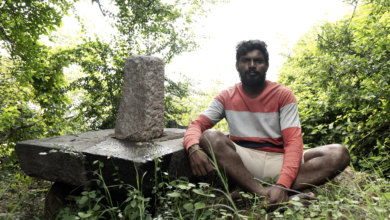
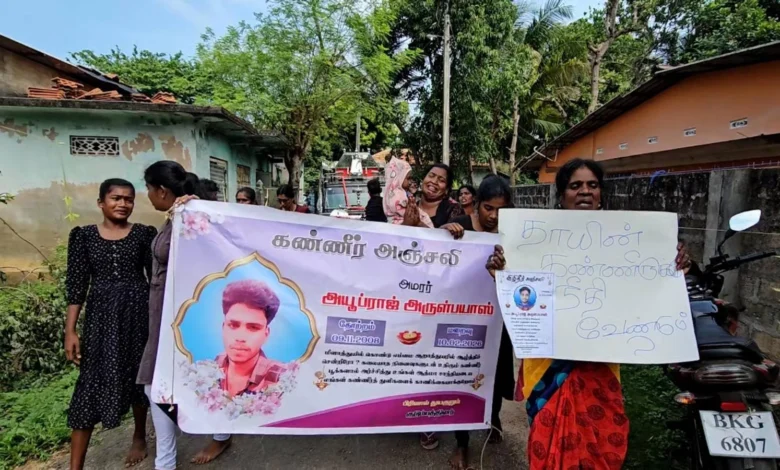
17 Years Old and Shot Dead: A Mother’s Unanswered Questions
Story | Parthiban Shanmuganathan | Photo | T.Piratheepan
“Sir, they mercilessly killed my innocent child who was just like a young boy, making him struggle and suffer before dying. Even this government will not deliver justice for this. Is there no justice for those who suffer like this? Is there no justice for the poor child I gave birth to, sir? Was the blood that flowed from my child not real blood? Was what happened in my house not a murder, sir? Why are they protecting him? Why is the government protecting the one who shot my child? My entire family trusted him, sir.”
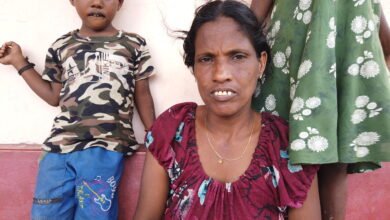
These are the tearful questions raised by Janaki Albino, the mother of 17-year-old Albino Arul Pious, who was killed in a police shooting.
On February 10, a 17-year-old boy, Arul Pious, was killed when Kayts police opened fire on a vehicle in Allaipiddy that failed to stop. Following the boy’s death, several conflicting reports emerged regarding the incident. There have been continuous calls for a thorough investigation, demanding that the police officers suspected of involvement in the shooting be properly investigated and punished and that justice be delivered to the affected family. As part of these demands, a protest was also held at the Jaffna bus stand. However, four weeks have now passed since the incident, and no one has been arrested so far. The affected parties allege that proper investigations have not yet been conducted.
Police Lies from the Very Beginning
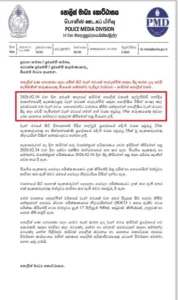
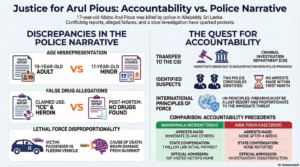
In a media statement released at 4:00 a.m. on February 11, the Police Media Division stated that a 19-year-old youth who had been traveling in a van died after being admitted to the hospital following a police shooting incident involving the vehicle on February 10. (Image 01)
The statement said: “On 10.02.2026, in the early hours of the morning, near the Allaipiddy junction within the Kayts Police Division, police officers signaled a suspicious van to stop. As the van failed to stop and continued moving, police opened fire. A 19-year-old youth who was traveling in the van was injured in the shooting and later died after being admitted to Jaffna Teaching Hospital.”
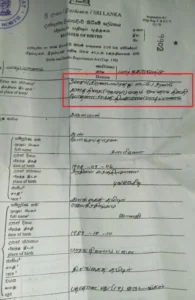
However, according to the birth certificate (Image 03) and the postmortem report of the deceased, Albino Ayubraj Arul Pious from Siththankeni was born on November 9, 2008. Therefore, it has been clearly revealed that the police attempted to portray the deceased as an adult youth, even though he was actually a 17-year-old minor.
Setting this aside, despite the existence of official documents confirming Pious’s age, Police Media Spokesperson F. U. Wootler stated at a press conference held on February 12 that the person who died in the police shooting was a 19-year-old youth. This further strengthened the suspicion that the police were attempting to conceal the truth.
When the deceased suspect was subjected to a medical examination, the police media division’s report stated that he had been using “ice” and heroin. However, in the post-mortem examination report sent by Judicial Medical Officer Rudrapasupathi Mayotharan to Judge M.N.N. Hussain, there is no mention that drugs were found in the body of the deceased. Therefore, the police’s earlier claim regarding drug use has been called into question.
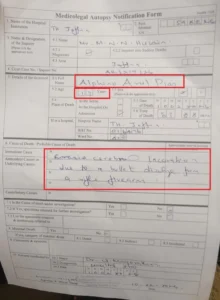
The cause of death of Arul Pious has been recorded as “brain damage caused by a bullet discharged from a firearm” (Image 02) in the postmortem examination report of Judicial Medical Officer Rudrapasupathi Mayotharan. If that is the case, the question arises as to whether the police opened fire merely to stop the vehicle.
Police Anarchy

University of Jaffna Professor Thiruvarankan Mahendran stated that the police and certain other parties are attempting to justify the killing committed by the police. He emphasized this matter during a protest held on the 22nd in Jaffna, demanding justice for the killing of the boy.
“The police shot and killed him on the grounds that he did not stop the vehicle while driving. Today, the police and other parties are attempting to justify that killing in various ways. This is an act of anarchy by the police. This once again shows us the violent face of the police. The very police who are supposed to uphold law and order in the country have misused their authority and killed a boy from a poor family. This is something that must be strongly condemned. The National People’s Power government, while claiming to promote good governance and function effectively, has taken no action whatsoever regarding this killing. We view this as an utterly negligent attitude.”
Mothers of the Tamil Homeland in Tears
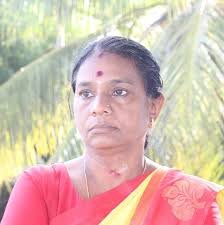
Vasuki Suthaharan, Director of the Eelam Tamil Women and Children’s Rights Protection and Advancement Organization, who participated in the protest, told the media that every mother in the Tamil nation sheds tears just like the mother of Albino Ayubraj Arul Pious.
“Human rights and fundamental rights have been stripped away. This boy is 17 years old. Not only was this boy murdered, but state machinery is also attempting to justify the killing with various explanations. If this 17-year-old boy was indeed shot and killed, then all those responsible must be held accountable and punished. When we see the pain of this family, every mother in the Tamil nation sheds tears in the same way. Such injustices continue to occur in many households. The state machinery, which spreads drug use and then remains silent while citing various excuses instead of protecting children, **ends up shooting and killing them.”
Strongly questioning why the killers had not been arrested even four weeks after the murder of the boy, she emphasized that all the perpetrators must be punished and the safety of Tamil children, Tamil women, and Tamil families living in the North and East must be ensured.
“The truth is that officials in high positions within the government are indirectly complicit in this crime. This is because four weeks have passed since this child died. But it is very saddening that neither justice for this boy nor the arrest of those responsible has taken place so far. Tamil children, Tamil women, Tamil youth, and Tamil families across the North and East must be protected,” she said.
The Shooting and Justice
This is not the first instance in Sri Lanka where firearms have been discharged at vehicles that defied police orders at road checkpoints — many such incidents have occurred previously. However, there have also been instances where justice was served for those affected by shootings, including cases where compensation was awarded to victims’ families.
On January 18, 2024, one person lost their life when a police officer opened fire on a lorry that allegedly defied police orders in the Kurunegala Narammala area. In connection with this incident, two persons, including the Sub-Inspector of Police involved, were arrested and dismissed from service. The then Acting Inspector General of Police personally visited the home of the deceased and handed over a cheque worth one million rupees as an initial compensation payment to his family members.
The deceased’s wife, Kamani Rubika Priyangani, filed a Fundamental Rights petition in the Supreme Court stating that her husband’s fundamental rights had been violated. A demand has been made for compensation amounting to 200 million rupees to be paid by the police officers involved and the state. The case hearing is currently underway.
Viewed on this basis, there is growing demand that similar legal action should be pursued in the case of the killing of this boy and that justice must be delivered.
When Can the Police Use a Firearm?
In Sri Lanka, the use of firearms by the police is a highly regulated authority governed by law. This is largely governed by the Penal Code, the Code of Criminal Procedure, the Constitution, the Police Department regulations, and guidelines issued by the Inspector General of Police (IGP).
Through Sri Lanka’s Penal (Amendment) Code, it is specified that police may use a firearm for self-defense if there is an immediate threat to life or risk of serious injury. In such situations, the necessary degree of force may be used to prevent that threat. However, using a firearm after the threat has passed is unlawful.
Under the Code of Criminal Procedure Act No. 15 of 1979, when a person being arrested on a serious charge resists and attempts to escape, permission is granted to use necessary force. However, lethal force must only be used as a last resort. It has also been pointed out that it is not justifiable to open fire on a person fleeing for a minor offense.
In the event of a riot or armed attack, a warning must first be issued. Less dangerous methods such as tear gas and water cannons should be used first. Firearms may only be used when there is a direct and immediate threat to life.
In accordance with IGP Circular No. 843 dated March 28, 2010, the use of firearms by police officers is restricted but not prohibited. Legal experts argue that while the law places limitations on firearm use, it still allows police officers to exercise discretion, which in some cases may be misused.
International Principles
During the Eighth United Nations Congress on the Prevention of Crime and the Treatment of Offenders held in 1990, the Basic Principles on the Use of Force and Firearms by Law Enforcement Officials were adopted.
These principles state that the primary purpose of using force and weapons must be to protect human life and fundamental rights. Force must only be used as a last resort and must always be proportionate to the threat faced.
Officials are required to respect the law and human rights while carrying out their duties. Excessive force or actions that create a direct threat to life must be avoided. Wherever possible, a clear warning such as “Stop or we will shoot” must be issued before firearms are used.
In reality, even international policies allow police to use firearms when absolutely necessary. However, concerns arise when firearms are used without genuine necessity, followed by reports claiming that such necessity existed.
The official Facebook page of the Sri Lanka Police states, “This is your police.” In reality, the question must now be asked whether the Sri Lanka Police truly serves the people —especially in the context of the death of Arul Pious.
How did the bullet that was fired at a vehicle that failed to stop end up destroying Pious’s brain?
Only the police officer who fired the shot knows the answer to that question.
The investigation is very slow
In connection with the killing of 17-year-old Albino Ayubraj Arul Pious, who was shot dead by the police, the court, expressing dissatisfaction with the investigation being conducted by the Kayts Police, has ordered the Inspector General of Police to hand over the investigation to the Criminal Investigation Department (CID).
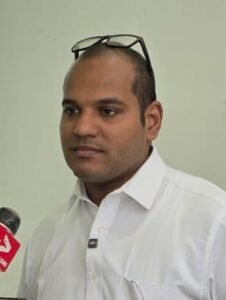
After considering the matters presented before the court on behalf of the affected party, Magistrate Nalini Subaskaran expressed her deep dissatisfaction regarding the ongoing investigations and directed that the case be transferred to the CID. Attorney-at-Law Dr.Kumaravadivel Gurubaran, who appeared in court on behalf of Albino Ayubraj Arul Pious from Siththankeni, who was killed in the police shooting on February 10, stated this on March 12.
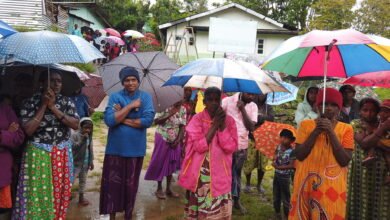
Condemning the police officers responsible for the killing of the minor and demanding their arrest, family members and civil society activists staged a protest for the second time within a month in front of the Kayts Police Station on March 10, 2026.
The six-member legal team representing the victim informed the court that even after one month since the killing, the names of the police officers responsible had not been included in the ‘B’ report and that the bullet used in the shooting had not yet been recovered. They pointed out that these facts clearly demonstrate the poor state of the investigation.
Attorney Kumaravadivel Guruparan further stated that the officer-in-charge of the District Crime Prevention Division had submitted a report to the court on February 10, 2026, indicating that shots had been fired from the firearms of Police Constables Marasinghe and Salman. However, the victim’s legal representatives questioned in court why the two suspects had not yet been arrested.
The attorney also noted that the police had submitted a report claiming that the shooting was carried out in self-defence. However, he emphasized before the court that even if the shooting had been conducted in self-defence, the officers should first be arrested, and bail could then be considered based on their explanations.
Accordingly, after considering the request made by the victim’s legal team to name and arrest the two police officers involved in the killing of Arul Pious as suspects, the magistrate issued the relevant order, Attorney Kumaravadivel Guruparan stated.
It is noteworthy that between fifteen and twenty police officers were present in court during the hearing of the case.